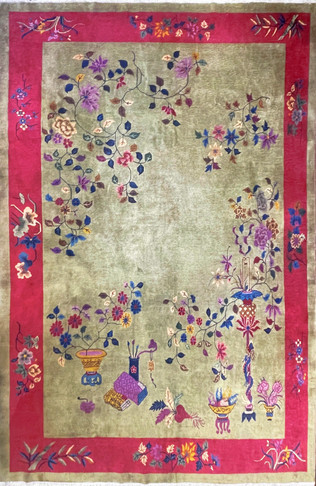
A particularly beautiful and unusual antique Chinese Art Deco carpet, distinguished by its soft celadon-green field, vibrant rose-red border, and wonderfully free-form floral composition. The open design gives the carpet a light, elegant appearance while allowing its remarkable colors and individual motifs to stand out.
The spacious pale celadon to soft sage-green field is decorated asymmetrically with flowering branches and trailing vines bearing peonies and other blossoms in shades of lavender, violet, rose, deep blue, burgundy, ivory, soft yellow, and green.
The Ghiordes captured the hearts of European collectors in the 1700s. Ture s, highly decorative spandrel and gorgeous monochromatic fields. These stunning rugs are typically made from the highest quality wool. This construction technique produces beautiful and extremely durable rugs.
Ghiordes include a marvelous variety of angular medallions, graceful curvilinear arabesques and repeating motifs. In general, antique Turkish carpets from the area tend to favor botanical motifs and florals rather than the angular symbols that are depicted in some Turkish rugs.
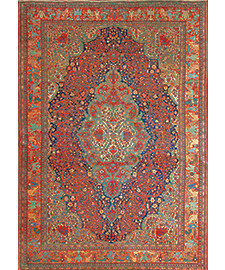
This magnificent antique Persian Manchester Wool Kashan carpet is an exceptional example of the finest workshop production from the golden age of Kashan weaving. Dating to approximately 1910, it was woven using luxurious imported Manchester-spun Merino wool, prized for its remarkable softness, silky sheen, and exceptional durability.
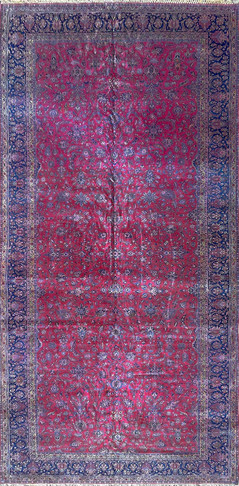
This elegant antique Indo Larestan carpet is a beautifully woven example of the early 20th-century Indian weaving tradition, inspired by the refined floral carpets of Persia. Produced around 1920, it reflects the high level of craftsmanship achieved by Indian workshops, which became renowned for weaving finely executed carpets using Persian-inspired designs and excellent-quality wool.
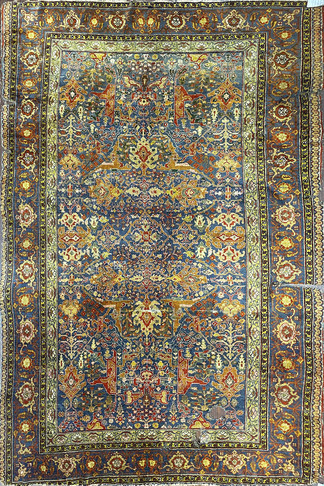
The rich midnight-blue field is decorated with an orderly allover pattern of stylized flowering plants, palmettes, and scrolling vines, creating a graceful and highly balanced composition.
Construction: Hand-knotted silk pile on a silk foundation
Condition: Structurally sound with good pile, but several holes, missing areas, and edge damage. The silk foundation remains stable and the rug is not dry or rotten.
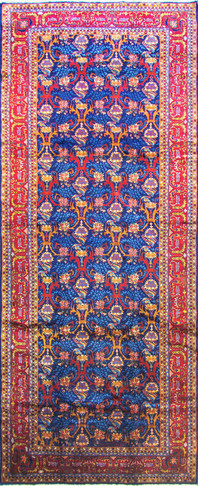
This rare antique Persian Silk Heriz rug is an exceptional survivor from the late 19th century, representing one of the most unusual and collectible variations of Heriz weaving. While Heriz rugs are traditionally woven in wool, silk examples from this period are exceedingly scarce and were likely produced as special commissions for affluent patrons.
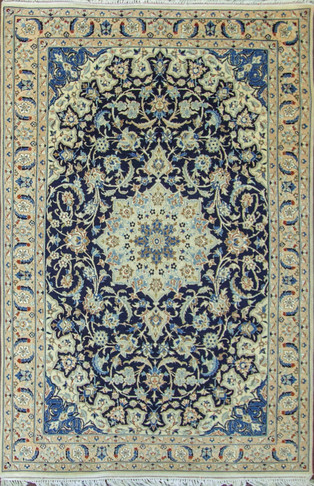
Wool and silk Persian rug.
Nain rugs are constructed using the Persian knot and typically have between 300 and 700 knots per square inch. The pile is usually very high quality wool, clipped short, and silk is often used as highlighting for detail in the design.
Construction: Hand-knotted, fine kork wool pile on a cotton foundation.
This elegant antique Persian Dabir Kashan carpet is an excellent example of the refined workshop production associated with the celebrated Dabir atelier of Kashan. Woven during the early 20th century, it displays the exceptional drawing, balanced proportions, and fine knot density that distinguish the finest Kashan carpets of this period.