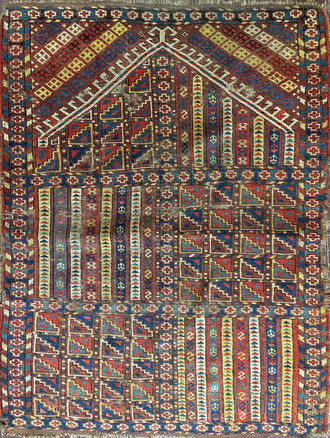
An exceptionally rare and highly unusual antique Yomud Turkoman prayer rug featuring one of the most distinctive compartmented designs encountered in Turkmen weaving.
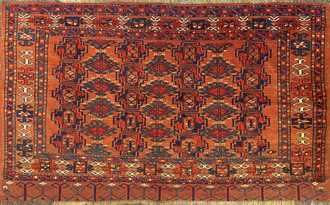
An attractive antique Turkoman tribal rug featuring an all-over arrangement of geometric ashik motifs and stepped octagonal forms on a warm terracotta-red field. The design is executed in rich shades of indigo blue, madder red, ivory, and soft brown, creating a balanced and highly decorative tribal composition.
The spacious field is framed by several finely drawn geometric borders incorporating traditional Turkmen protective symbols and stylized tribal devices.
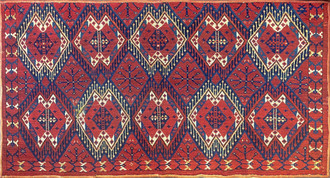
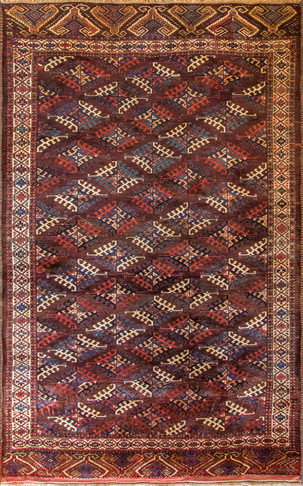
An attractive antique Yomud Turkoman rug fragment featuring an all-over lattice of large hooked diamond medallions set against a rich madder-red field. The dramatic geometric composition is enhanced by deep indigo-blue motifs, ivory highlights, and numerous tribal symbols arranged in a highly rhythmic pattern.
The wool displays excellent sheen and retains strong natural dyes, particularly the saturated madder red and dark indigo blue.
The design is the key. This is not a standard gul carpet. It belongs to the rare Hatchli (Hatchlu) group, a type associated with early Turkoman weavings. The compartmented layout, architectural lattice, tree-like motifs, stepped forms, and unusual geometric panels differ significantly from the repetitive gul patterns found in most Tekke rugs.An exceptionally rare and highly decorative antique Turkoman Hatchli rug woven during the mid-19th century.
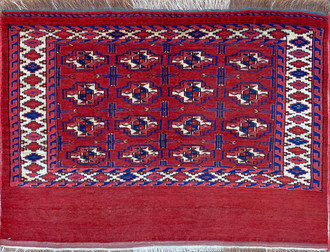
This handsome antique Turkoman rug displays a classic tribal composition featuring eight well-drawn elephant-foot guls arranged in a balanced field. The rich palette of deep aubergine, burgundy, rose-red, soft pink, ivory, and dark brown creates the warm, saturated appearance collectors seek in older Turkoman weavings.
The border system is particularly attractive, consisting of multiple guard borders surrounding a main border filled with geometric rosettes and tribal ornaments.
Embark on a journey through time as we unravel the rich history woven into the fabric of Turkmen rugs, a testament to the nomadic tribes that crafted these masterpieces centuries ago. In an era long past, these artisans relied on locally-sourced materials—wool from their herds and vegetable or natural dyes extracted from the bountiful land surrounding them. The result was a symphony of colors and patterns that reflected the unique identity of each tribe.
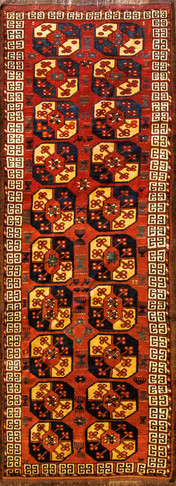
This runner has a rich color's field that displays two columns of characteristic octagonal Ersari tribal guls quartered in gold green and blue. There is a abrashes lighter in the red. A very attractive Central Asian Turkmen carpet in quite good condition with only minimal wear.
The guls throughout of the runner are in different dimension, that is a good sign of the old age and made in the village and it didn't made for export.
Yomut or Yomud is a Turkmen tribe that lives from Gorgan to Turkmenbashi and eastern Caspian shores and Khiva and Dashoguz.
The colors, primarily burnt sienna with ivory borders, are used to create diagonal or vertical arrangements. These antique tribal Oriental rugs are more colorful than other Turkoman rugs. Repetitive floral motifs, tree motifs and the less frequent bird motifs adorn the centerfield.
Yomut rugs are among the most popular varieties of Turkoman carpets available.