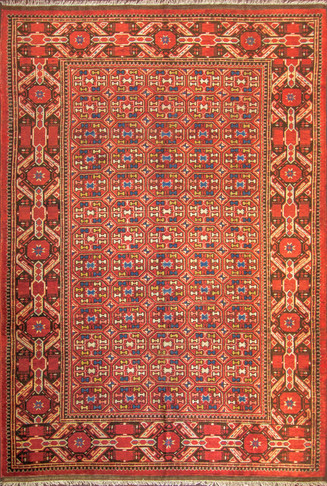
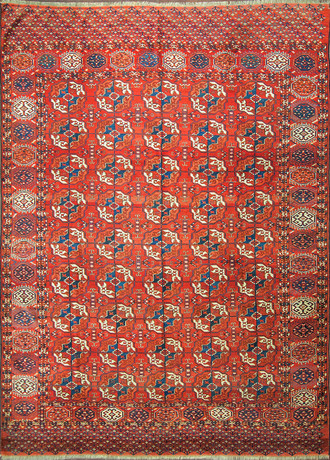
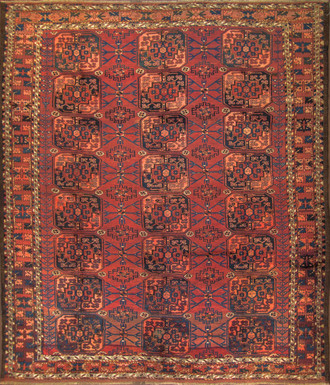
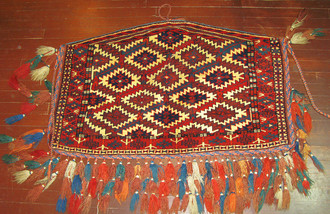
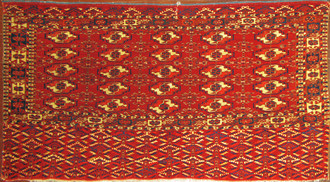
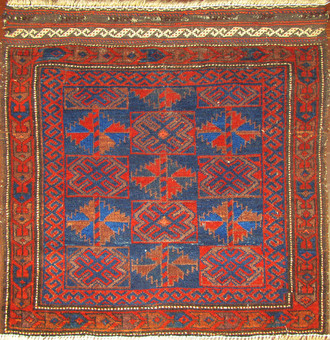
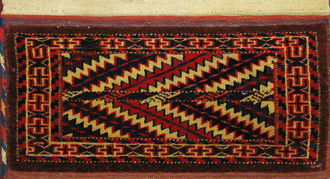
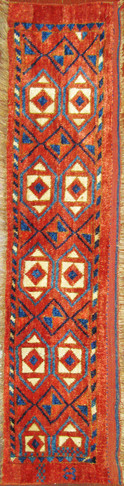
The Beshirs produced their rugs in the Khanate of Bokhara. Unlike other Turkoman tribes, the Beshir pursued a distinct weaving style. Featuring bright colors , antique rugs from the Beshir tribe feature large motifs and stylized flowers. Placing an emphasis on floral patterns and all over designs, these antique rugs are heavily sought after because of their distinct style.
Beshir rugs are made by the Beshir tribe, one of several subdivisions of the Ersari group of Turkoman people, who inhabit the Amu Darya Valley in Turkmenistan and parts of Uzbekistan and Afghanistan.
The standard designs used by the Tekke vary according to the nature of the weaving.
Main Carpets. The Tekke gul was used almost exclusively as the major gul in the field of main carpets. Minor guls usually are either the chemche or gurbaghe (also called the kurbage) gul.
On Tekke carpets which were made up to ner the end of the 19th century, the major border is on a red ground and contains rows of octagons, usually filled either with four small eight-pointed stars (occasionally one large star) or with a kotchak-cross ornament.
The Ersari Tribe includes the Beshir, Charshango and Kizil Ayak as sub groups. The Ersari tribe and other Turkoman groups began moving into the north-eastern Afghanistan from early seventeenth century and they continued their weaving craft. Most rugs from that area till the 20th century where made by Turkomans and Baiuchi tribes and not by Afghans and it is appropriate labelled as "Ersari Afghan".
The Ersaris used undyed weft which is visible along its entire length is a characteristic feature.
The ivory field woven with vertical rows of blue and rose stepped medallions within a rose geometric border flanked by running dog variation guard borders.