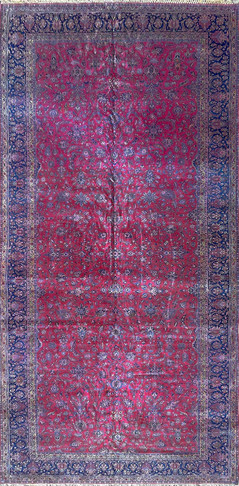
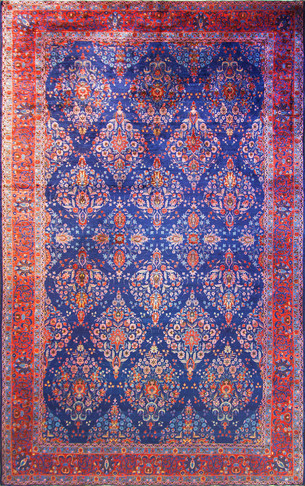
This magnificent antique Persian Manchester Wool Kashan carpet is an exceptional example of the finest workshop production from the golden age of Kashan weaving. Dating to approximately 1910, it was woven using luxurious imported Manchester-spun Merino wool, prized for its remarkable softness, silky sheen, and exceptional durability.
Kashan rugs have for a long time been considered the essence of Persian rugs. Almost inevitably, the initial association when a Persian rug is mentioned is an ornate oriental rug with a strong pattern with bold reds and blues. While Kashan rugs certainly have made a lasting impression with these colors, the evolution of such weavings is really an awesome conglomeration of many different styles, colors and variety. Some spectacular and very fine pieces have been produced in Kashan for many, many years.
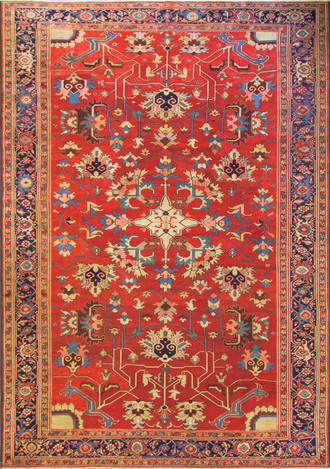
A Bakshaish, Serapi, Master piece.
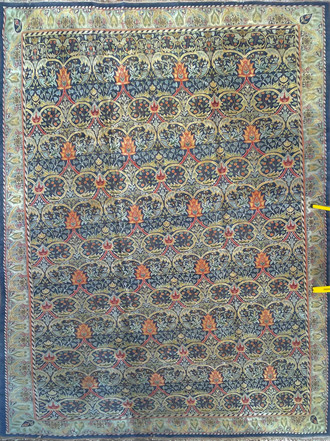
Very unusual all-over geometric and floral design made in northwest Persia. The carpet portrait a central medallion with four birds in the centre and one fourth of the same medallion is in each corner of the rug.
Bakshaish, Heriz Serapi. Bakshaish rugs made in Persia, Bakshaish (Bakshaish or Bakhshaysh) rugs adapt the style and feeling of the finest smaller village or tribal rugs to the scale of room-size pieces. The drawing of Bakshaish rugs and carpets is always bold, geometric, dynamic, and abstract.
Antique Sultanabad rugs The city of Sultanabad (which is now known as Arak) was founded, in the early 1800s, as a center for commercial rug production in Iran. During the late 19th century, the firm of Hotz and Son and Ziegler and Co. established a manufactory in Arak/Sultanabad whose sole objective was to produce rugs to meet the western demands. They even brought over western designers to conform to the western tastes of the time. This was the first instance of a hands-on western influence in the industry (which until this point was sheltered from western insights).
A Timeless Masterpiece: The Exquisite 30-Year-Old Nepal Carpet.
In the world of fine rugs, few treasures can match the enduring beauty and artistry of a Nepal carpet. This magnificent piece, measuring an impressive 22 feet in length and 14 feet, 9 inches in width, stands as a testament to the rich traditions of Himalayan craftsmanship. With three decades of history woven into its fibers, this rug represents not just an exquisite floor covering but a work of art that has gracefully stood the test of time.
Crafted from the finest natural fibers, your Nepal carpet is a testament to quality.
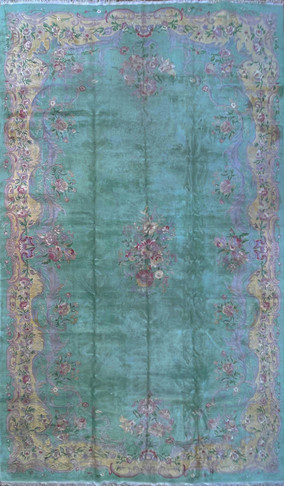
Step into a world of rare elegance with our exquisite Art Deco Rug, a true marvel from the 1950s that carries the allure of a bygone era. Crafted with precision in China, this rug is a testament to the impeccable craftsmanship of its time. Remarkably preserved in excellent condition, it boasts a color palette that is both unusual and breathtakingly beautiful - a serene light green background and light gold, pink border complemented by a regal multi color floral pattern.
The rug's design is a masterpiece in itself, featuring traditional Aubusson floral design and central medallion.
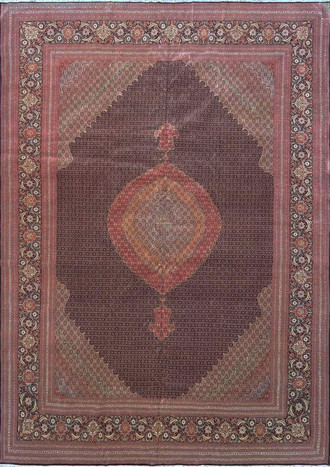
Fine Persian Tabriz Mahi Carpet, Fifty rage Quality.
Typical of the Mahi carpet is their use of the distinctive symmetric Turkish knot and fine Kurk wool with silk accents. The Tabriz Mahi likewise possesses a high knot per square inch count (KPSI) increasing their quality by bounds. The standard Persian Mahi rug from Tabriz is at a rate of 80 knots per square inch.
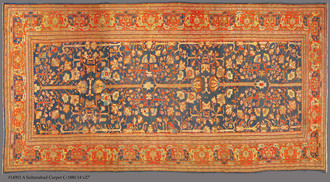
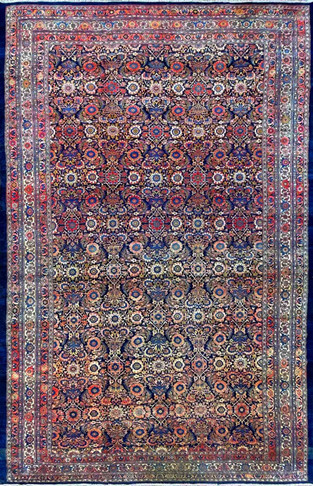
Step into the allure of history with this magnificent over-sized antique Persian Malayer carpet, measuring an impressive 11'6" x 19'4". Transporting us back to the late nineteenth century, this rug not only bears the marks of time, evident in its gentle wear, but it also stands as a testament to the enduring quality of Persian craftsmanship.
The regal blue background serves as a captivating canvas for the overall geometric designs that adorn this masterpiece. The rug's condition, while reflective of its age, only adds to its charm and authenticity.