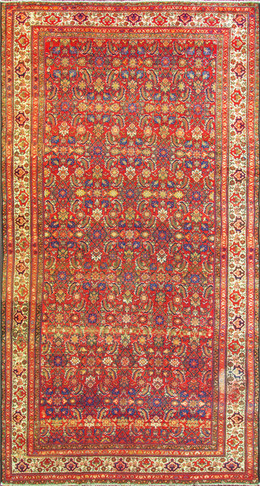
A very busy Herati center and a pleasant border design with running water and trees. The tribal weavers in Malayer were often Turkish, and they employed the Turkish knot, Gourde, to weave these creations. The Gourde is a symmetrical knot, as opposed to the asymmetrical knot of many traditionally Persian creations. Additionally, antique Malayer rugs regularly enjoy a low cut pile. Weavers trimmed the pile in order to enhance the appearance of the design.
Caucasian rugs are primarily produced as village productions rather than city pieces. Made from materials particular to individual tribal provinces, the rugs of the Caucasus normally display bold geometric designs in primary colours. Styles typical to the Caucasus region are Daghestan, Shirvan, Gendje rugs, Kazakh and Quba rugs. Several carpet styles from contemporary northwestern Iran also fall largely into this bracket, such as the Ardabil rugs. Measures: 3'4" x 6'5".
This rug has fine weave and incredible design and colors.
The district of Shirvan produced many highly decorative antique rugs that have complexity that is found in few rugs from the Caucasus. Shirvan, which is part of modern-day Azerbaijan, was populated by Azeri Turks and some Armenians, who were expert dyers and weavers. Grand symbol-filled medallions with polychrome accents are featured prominently as are all-over Afshan patterns, which are a sort of angular arabesque filled with dramatic harshang palmettes. Stunning all-over patterns featuring symbolic devices and a latticework of angular floral sprigs are also used.
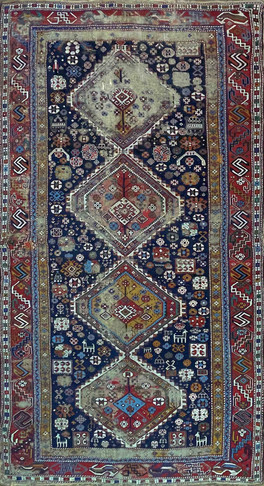
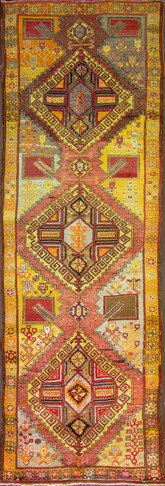
The rug has the heavier, more strongly geometric character associated with Kazak weaving rather than the generally finer, more closely articulated drawing of Shirvan. The construction visible from the back, the bold scale of the medallions, and the powerful geometric field all support that attribution.
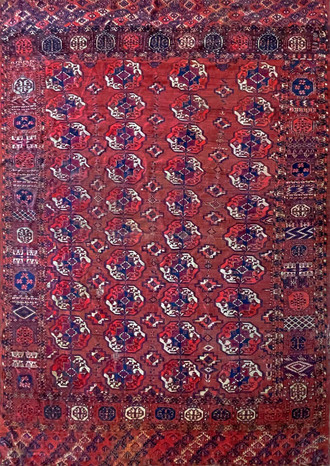
Embark on a journey through time as we unravel the rich history woven into the fabric of Turkmen rugs, a testament to the nomadic tribes that crafted these masterpieces centuries ago. In an era long past, these artisans relied on locally-sourced materials—wool from their herds and vegetable or natural dyes extracted from the bountiful land surrounding them. The result was a symphony of colors and patterns that reflected the unique identity of each tribe.
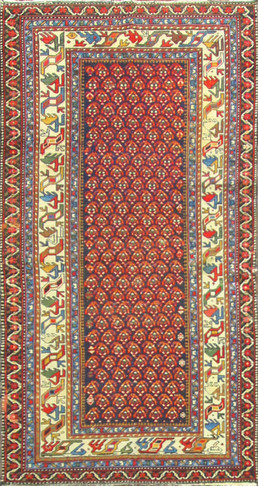
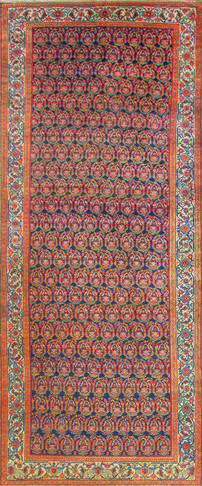
A very attractive and finely woven late-19th-century Persian Senneh Malayer carpet in an unusually desirable long gallery format. The carpet features a dense all-over arrangement of repeating boteh motifs, carefully organized in horizontal rows across a rich, very dark indigo-blue field. This type of boteh drawing has strong associations with both Senneh and Malayer weaving traditions.
Each boteh is intricately worked with small floral elements in shades of madder red, rose, salmon, ivory, soft green, blue and touches of yellow.
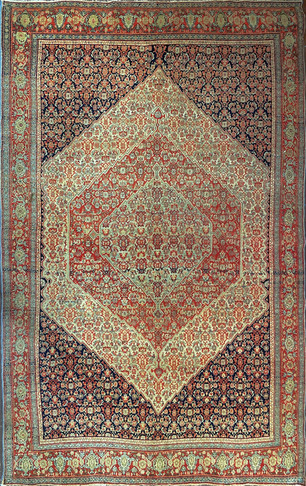
A very fine late 19th-century Persian Senneh carpet, distinguished by its exceptionally intricate drawing, finely woven construction, and striking geometric composition. The design is centered by a large layered diamond medallion, with an ivory outer medallion surrounding a warm madder-red center.
An absolutely amazing handwoven Turkish Oushak carpet with unusual repeated boukuetof flowers.
The colors are muted and highly stylized floral accent.
originally purchased from a nice west cost collection that I consider it a great find.
Ushak rugs have been in production since the 15th century with superb wools and natural dyes. Unlike other Turkish rugs, Ushak rugs influenced after Persian rugs and woven with Ghiordies knots, their design is feature intricate motifs of vines and leaves.
The materials are wool pile with cotton foundation.