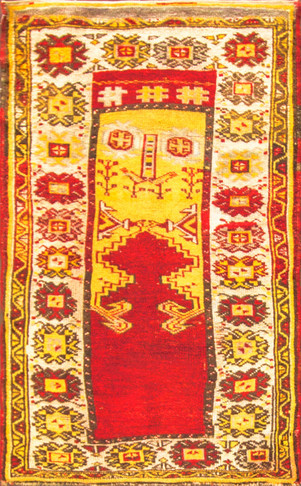
The city of Uşak, Turkey, one of the larger towns in Western Anatolia, which was a major center of rug production from the early days of the Ottoman Empire, into the early 20th century.
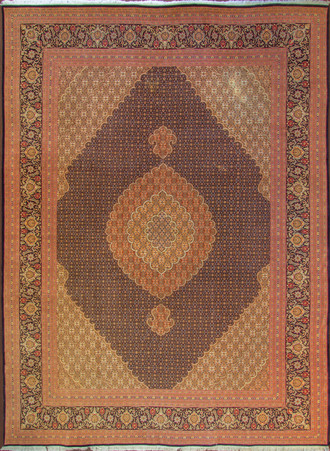
Popular colors and antique or modern design.
almost all Turkmen rugs were produced by nomadic tribes almost entirely with locally obtained materials, wool from the herds and vegetable dyes, or other natural dyes from the land. They used geometrical designs that varied from tribe to tribe; most famous are the Yomut, Ersari, Saryk, Salor, and Tekke. Irregularities — considered part of the charm by many rug collectors — were fairly common since natural materials varied from batch to batch and woolen warp or weft may stretch, especially on a loom that is regularly folded up for transport and set up a new at another camp.
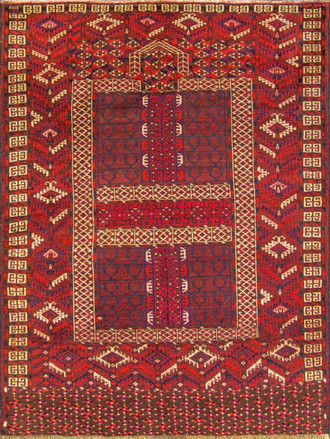
An exceptionally attractive matched pair of antique Tekke Turkmen chuval faces, dating to the late nineteenth century and surviving together in remarkably fine condition.
Each piece displays the classic six-gul composition, arranged in two horizontal rows of three large turreted guls across a rich crimson-to-deep madder-red field.
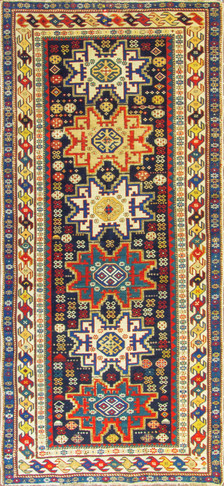
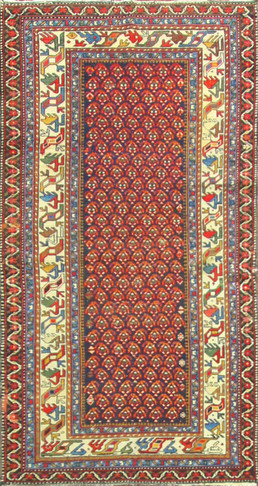
Looking closely at the design and the back, I think Shirvan is a good attribution for this runner. The relatively fine weave, elongated format, crisp geometric drawing, numerous small field ornaments, and complex multiple-border system are all consistent with late-19th-century Shirvan work.
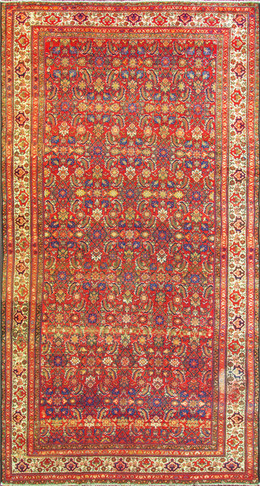
A very busy Herati center and a pleasant border design with running water and trees. The tribal weavers in Malayer were often Turkish, and they employed the Turkish knot, Gourde, to weave these creations. The Gourde is a symmetrical knot, as opposed to the asymmetrical knot of many traditionally Persian creations. Additionally, antique Malayer rugs regularly enjoy a low cut pile. Weavers trimmed the pile in order to enhance the appearance of the design.
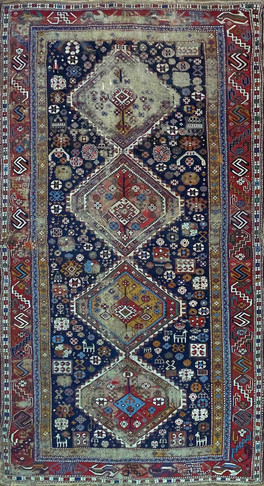
Caucasian rugs are primarily produced as village productions rather than city pieces. Made from materials particular to individual tribal provinces, the rugs of the Caucasus normally display bold geometric designs in primary colours. Styles typical to the Caucasus region are Daghestan, Shirvan, Gendje rugs, Kazakh and Quba rugs. Several carpet styles from contemporary northwestern Iran also fall largely into this bracket, such as the Ardabil rugs. Measures: 3'4" x 6'5".
This rug has fine weave and incredible design and colors.
The district of Shirvan produced many highly decorative antique rugs that have complexity that is found in few rugs from the Caucasus. Shirvan, which is part of modern-day Azerbaijan, was populated by Azeri Turks and some Armenians, who were expert dyers and weavers. Grand symbol-filled medallions with polychrome accents are featured prominently as are all-over Afshan patterns, which are a sort of angular arabesque filled with dramatic harshang palmettes. Stunning all-over patterns featuring symbolic devices and a latticework of angular floral sprigs are also used.