This exceptional Antique Caucasian Karabagh Runner, woven around 1890, is a magnificent example of the artistic tradition of the Karabagh weaving region. Its extraordinary length and elegant allover composition make it an ideal statement piece for a grand hallway, gallery, or expansive interior requiring a truly distinctive antique textile.
The deep midnight blue field is richly adorned with an allover arrangement of stylized floral sprays, palmettes, and delicate vine work rendered in vibrant shades of crimson, raspberry, ivory, soft sky blue, sage green, and golden yellow.
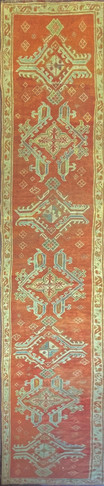
This striking Antique Turkish Oushak runner, woven around 1890, is an elegant example of late nineteenth-century Anatolian craftsmanship. Its exceptional length and beautifully balanced geometric composition make it an ideal hallway runner while also serving as a highly decorative collector's piece.
The warm soft terracotta field is arranged with a procession of bold, stylized geometric medallions, each displaying distinctive hooked motifs and intricate latch-hook forms characteristic of the finest Oushak village weavings.
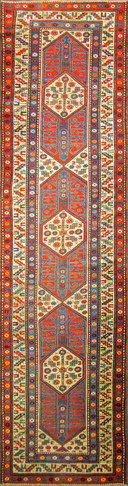
This exceptional Antique Caucasian Kazak Kurdish Runner, woven around 1900, is a striking example of the bold geometric artistry and outstanding craftsmanship for which the finest Caucasian village weavings are celebrated. Its elongated proportions make it an ideal hallway runner while preserving the powerful tribal character that distinguishes authentic antique Kazak rugs.
The ivory field is anchored by a dramatic procession of three large, elongated hexagonal medallions in rich terracotta and sky blue.
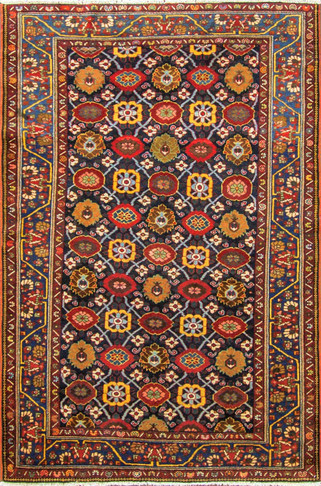
This handsome antique Persian Bakhtiari rug, woven around 1890, is a richly colored and highly decorative example of late 19th-century tribal weaving. It features an elegant allover lattice design filled with alternating floral medallions, rosettes, and stylized blossoms arranged across a deep midnight-blue field.
The repeating motifs are woven in warm shades of madder red, rust, golden yellow, soft green, ivory, and muted blue, creating a lively but well-balanced composition.
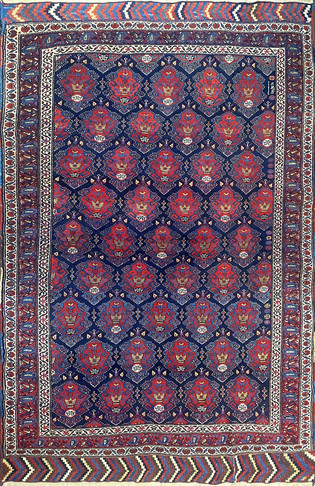
This is a beautiful antique Persian Afshar rug, woven by the renowned Afshar tribes of southeastern Persia. It features a striking allover boteh (paisley) design arranged in neat rows across a rich midnight-blue field, creating a wonderfully balanced and highly decorative composition. The vibrant crimson botehs, accented with ivory, sky blue, and golden highlights, stand out dramatically against the deep indigo background.
One of the rug's most distinctive features is its colorful kilim end finish, displaying the traditional chevron pattern characteristic of fine Afshar weavings.
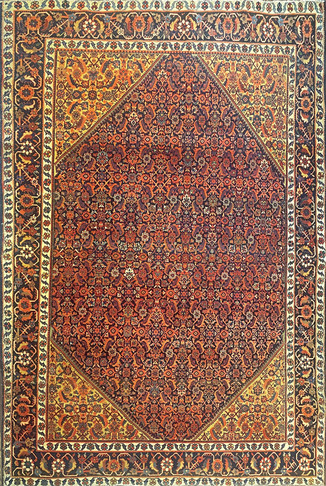
This exceptional antique Persian Feraghan rug, woven circa 1880, is a beautiful example of one of Persia's most celebrated weaving traditions. Measuring 4'6" × 7'4", it displays the refined craftsmanship and artistic sophistication that have made Feraghan rugs highly prized by collectors for well over a century.
The rug features a richly detailed Herati (Mahi) pattern covering the entire field, framed by ivory spandrels and an elegant floral border. The intricate allover design creates remarkable visual depth while maintaining perfect symmetry and balance.
This extraordinary antique Persian Feraghan, woven circa 1870, is an exceptional collector's rug distinguished by its remarkable fineness, unusual artistic design, and superb state of preservation. Representing the golden age of Feraghan weaving, it is a rare example of the creativity and technical mastery that made these carpets among the most admired of all 19th-century Persian rugs.
The dramatic midnight navy field is filled with an exceptionally intricate all-over lattice of Herati motifs, creating a rich tapestry of finely drawn geometric flowers, rosettes, and curling leaves.
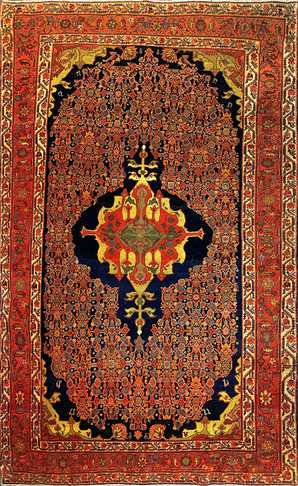
A beautiful antique Persian Bidjar dating to approximately 1920, handwoven with the exceptional craftsmanship that has earned Bidjar rugs the reputation as the "Iron Rugs of Persia." Renowned for their incredibly dense weave and outstanding durability, Bidjar rugs are among the most structurally robust Persian carpets ever produced.
This example features a rich deep terracotta-red field adorned with an intricate allover Herati (Mahi) pattern, centered by a striking ivory and navy medallion.