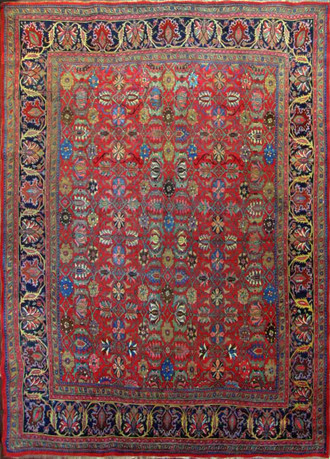
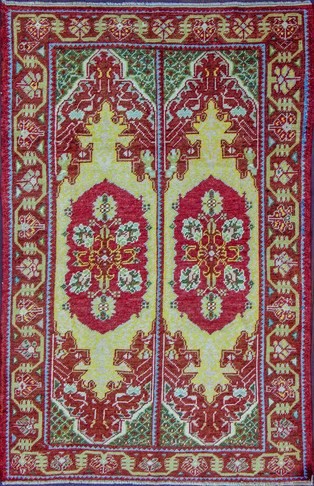
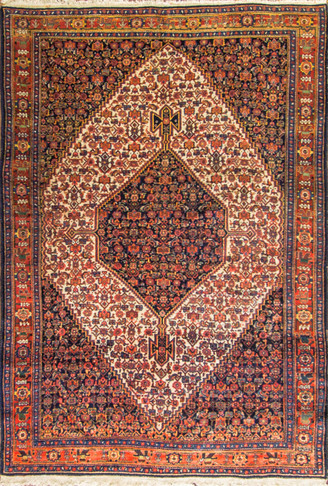
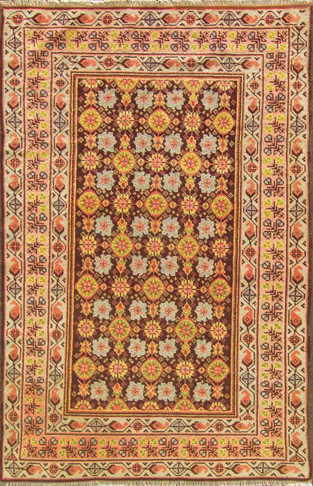
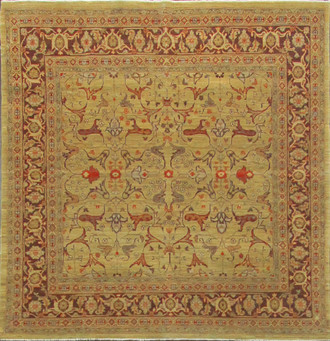
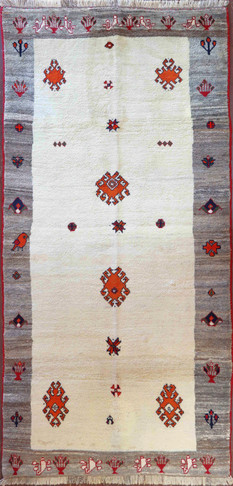
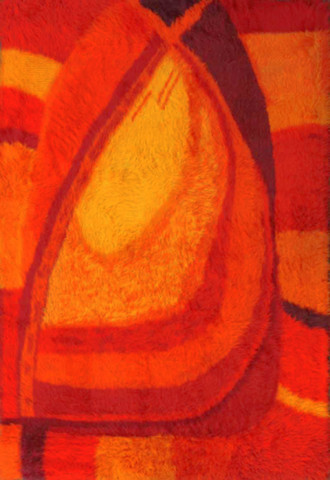
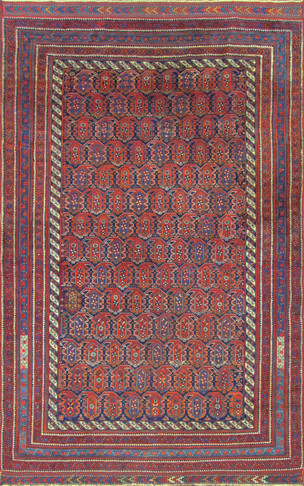
Quba rugs and carpets are named for a town that is located within the Daghestan region of Caucasus not far from the Caspian Sea; therefore, making Kubas a subdivision of Caucasian carpets. Kuba is at once a city and an area that was formerly a Khanate of Azerbaijan. Within the Kuba genre itself, there exist many subdivisions including: Alpan-Kuba, Karagashli, Konaghend, Chi Chi, Perepedil, Seychour and Zejwa.
Antique Caucasian Kazak Prayer Rug
Size: 3'1" x 5'1"
Origin: Caucasus, likely Bordjalou / Lori-Pambak region
Date: Dated 1313 AH (circa 1895–1896)
Construction: Hand-knotted wool on wool
This striking late 19th-century Caucasian rug represents a bold example of Kazak village weaving, executed in a classic prayer (mihrab) format.
Made in south-eastern Caucasus, bordering on north-western Iran.
This rug foundation and pile both are wool.
The design is significantly unique, specially the black border and the center medallion, therefore it is unique and important rug from every aspect.
A typical Navajo rug has approximately 30 wefts to the linear inch. A two grey hills from Toadlena average about 45. The finer pieces frequently have upwards of 80. When a textile has 80 or more wefts per inch, it is considered a tapestry, not a rug. The most famous weaver of these textiles was Daisy Taugelchee (1909-1990), who wove upwards of 115 wefts per inch, which created the most finely woven Navajo tapestries anywhere.
The weavers preferred to use natural wool from their sheep rather than the commercially produced wool used by other Navajo weavers.
This is an authentic handmade rug. It was made in Kurdish town circa 1910s or before. The materials are wool pile with cotton foundation. The colors are from vegetable dyes, and the general pattern is geometric design inside two borders.
The overall condition is good, especially when its age is taken into consideration. There are no tears, breaks or holes. The side bindings are intact and original. The ends are bound. The pile is high. The rug has been professionally washed.
This runner has a rich color's field that displays two columns of characteristic octagonal Ersari tribal guls quartered in gold green and blue. There is a abrashes lighter in the red. A very attractive Central Asian Turkmen carpet in quite good condition with only minimal wear.
The guls throughout of the runner are in different dimension, that is a good sign of the old age and made in the village and it didn't made for export.
Yomut or Yomud is a Turkmen tribe that lives from Gorgan to Turkmenbashi and eastern Caspian shores and Khiva and Dashoguz.
The colors, primarily burnt sienna with ivory borders, are used to create diagonal or vertical arrangements. These antique tribal Oriental rugs are more colorful than other Turkoman rugs. Repetitive floral motifs, tree motifs and the less frequent bird motifs adorn the centerfield.
Yomut rugs are among the most popular varieties of Turkoman carpets available.
A dynamic and exciting composition, this gorgeous late 19th century Bidjar runner from the 1880s showcases some of the finer qualities exhibited by the Persian iron rug of Iran. This antique Bijar is a historical rug woven in the village of Halwai, North-East of Bijar. This Halwai Persian Bidjar is immersed in Persian culture and reflects first-class prestige, a true collector’s piece. This beautifully detailed Persian Bijar boasts an ornate elaborate all-over pattern, rendered in exquisite detail. The intricate finials seem to float majestically within its abashed red open field.