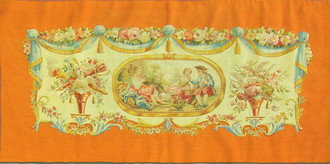
Tapestry manufacture at Aubusson and in the upper valley of the Creuse in central France.
They have developed from looms in isolated family workshops established by Flemings that are noted in documents from the 16th century.
The town of Felletin is identified as the source from which came the Aubusson tapestries in the inventory of Charlotte of Albret, Duchess of Valentinois and widow of Cesare.
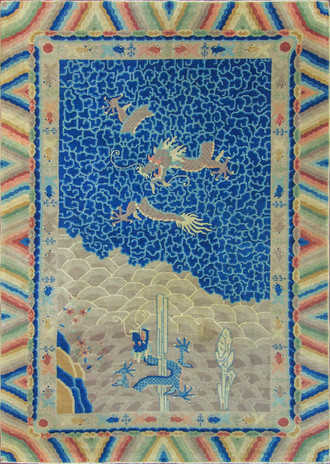
Antique Chinese rug, Origin: China, Here is a compelling and exciting antique Dragon rug, woven in China. Vibrant and beautifully preserved, the colors in this antique Chinese carpet are remarkable. Much the same could be said about the drawing, which is incredibly precise and meticulously done. A dragon is arranged against a blue field, within which are several smaller, traditional Chinese elements of design, including clouds and other decorative elements. The dragon him selves is majestic and intimidating , his long body extending.
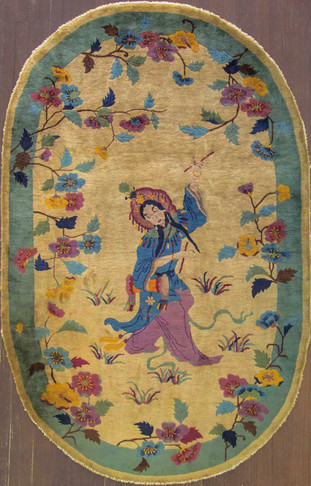
A famous Chinese dancing woman surrounded with beautiful garden of flowers
and the amazing background color including beautiful colors of the clothing.
This wonderful Art Deco carpet was made in China, circa 1920s. Walter Nichols was great American rug producer (the Art Deco rugs which he did not originate them) in Tientsin. The rugs made of wool and silk with bold vibrant colors and the pattern are pictorial scenes and trees, birds, clouds, mountains, dragons, butterfly and flowers. The production of Art Deco rugs started from 1910s-1950s and mostly with western influence.
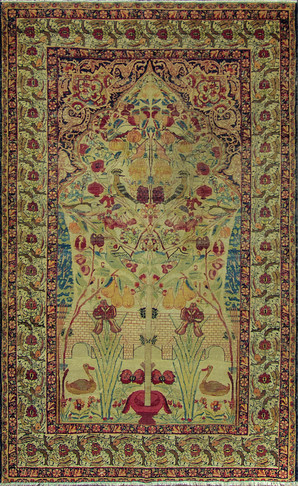
Striking Antique Kermanshah rug, c-1880. Pictural scene of three of life surrounded with birds and fish trees and plants.
The rug has a very fine weave and pleasant colors.
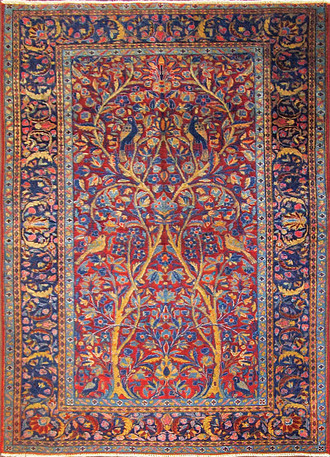
Kirman was a very important antique rug weaving center dating from the Golden Age of Persian culture under the Safavid Dynasty in the 16th century, on a par with Tabriz and Kashan in esteem. The color palette of Laver Kirman antique Persian rugs is unusually soft and delicate with a European grace.
A Kashan rug made in Persia in the city of Kashan in Isfahan Province North Central Iran. There was production of Persian carpet at Royal workshops in the 17th and early 18th century. The Persian carpet workshops ceased production in about 1722 after the Afghan invasion. Persian carpet production was very minor until the 20th century. Historically, Kashan was a major center in the garment trade. In the late 19th century, the market shifted and the local industry went from fine wool cloth to fine wool carpets. High quality wool was sourced from Sabzevar.
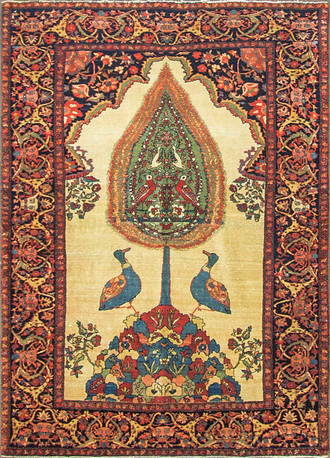
A very fine and unusual antique Persian Feraghan Sarouk featuring an elegant Tree of Life design rising from a flowering garden mound against a luminous ivory field. At the center stands a magnificent cypress-like flowering tree populated with birds and floral ornament, flanked below by a pair of peacocks rendered in rich shades of sapphire blue, rose, ivory, and soft green.
The spacious ivory field creates a striking contrast with the intricately drawn midnight-blue border, which is filled with scrolling vinery, palmettes, rosettes, and flowering arabesques.
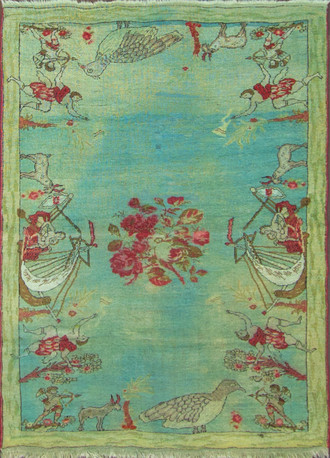
Unusual Pictural Oushak Rug. Greek mythology story. Probably Armenian Rug.
Antique Turkish Oushak rugs have been woven in Western Turkey since the beginning of the Ottoman period. Historians attributed to them many of the great masterpieces of early Turkish carpet weaving from the fifteenth to the seventeenth centuries. However, less is known about what happened to production there in the eighteenth and early nineteenth centuries. When things become clearer toward 1900, the Oushak region re-emerges as a major center, this time for room-size decorative rugs.
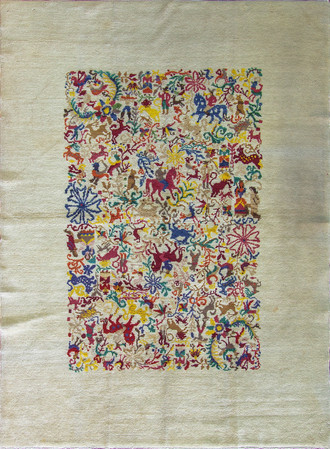
Ecuadorian rugs and textiles have existed in the Andean Region since Pre-Columbian times. Upon the arrival of the Spanish in the 15th century, the rug industry in the region rapidly expanded. Due to this increased demand, the Spanish colonizers began producing large textile workshops in the highlands. This was the beginning of large-scale carpet production in the Andes. Significantly widespread incorporation of traditional folklore and motifs particular to Ecuador into rug production.