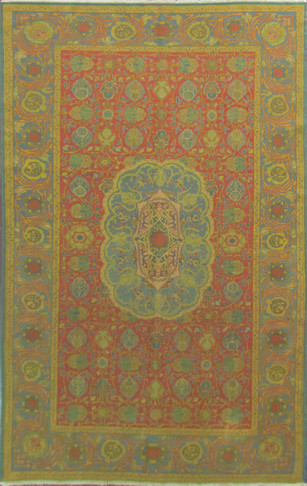
Bezalel rugs and carpets were produced in the early to mid-20th century as part of a new art school for Jewish immigrants in what was then British-ruled Palestine. Founded by Boris Schatz from Bulgaria in conjunction with Zionist pioneer Theodore Herzl, the Jerusalem workshop and art school were established creative and supportive place for Jewish artists.
Bezalel rugs woven in Israel often have Holy Land themes and display a blend of Jewish, Persian, Turkish and European styles. The construction and warm color pallet of Bezalel rugs resemble many Anatolian Rugs of the Ottoman dynasty.
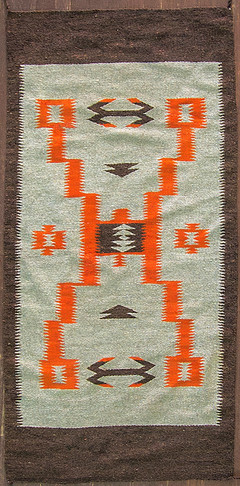
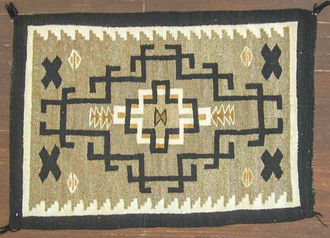
Storm pattern Navajo Rug, c-1930 in excellent condition.
The Storm Pattern is not built around a central diamond, but is a very recognizable geometric composition with a strong, often rectangular central element connected by diagonal stepped lines to elements in each of the four corners. This design is said to be highly symbolic and associated with the all-important rainstorms in the growing season. Individual components include representations of the Navajos’ four sacred mountains, lightning bolts, snowflakes and water-bugs. Storm Pattern rugs are woven in an unlimited variety of colors.
The weavers preferred to use natural wool from their sheep rather than the commercially produced wool used by other Navajo weavers. After the wool was carded together it was spun very fine, sometimes even as fine as thread. These threads allowed the weavers to weave more wefts to the linear inch, which created a textile of a much higher quality than other Navajo weavings.
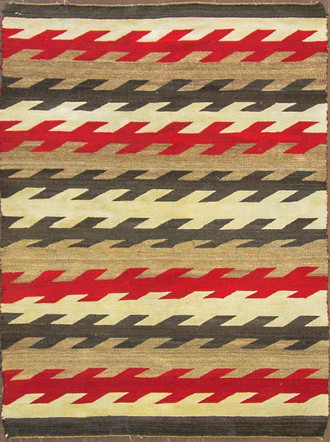
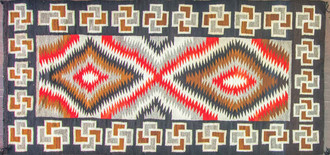
45" x 75" Unusual Eye-dazzler Navajo Rug, c-1890 in excellent condition,
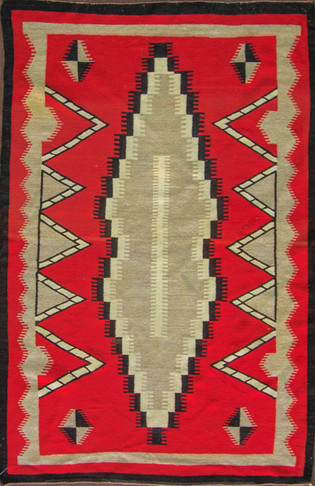
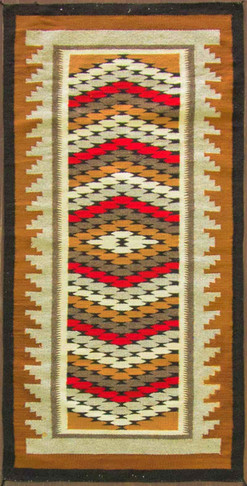
A classic Navajo rug circa 1890's in excellent condition. Homespun native wool with natural wool colors, vegetal dye.
The weavers preferred to use natural wool from their sheep rather than the commercially produced wool used by other Navajo weavers. After the wool was carded together it was spun very fine, sometimes even as fine as thread. These threads allowed the weavers to weave more wefts to the linear inch, which created a textile of a much higher quality than other Navajo weavings.
The weavers preferred to use natural wool from their sheep rather than the commercially produced wool used by other Navajo weavers. After the wool was carded together it was spun very fine, sometimes even as fine as thread. These threads allowed the weavers to weave more wefts to the linear inch, which created a textile of a much higher quality than other Navajo weavings.
A typical Navajo rug has approximately 30 wefts to the linear inch. A Two Grey Hills from Toadlena average about 45. The finer pieces frequently have upwards of 80. When a textile has 80 or more wefts per inch, it is considered a tapestry, not a rug. The most famous weaver of these textiles was Daisy Taugelchee (1909-1990), who wove upwards of 115 wefts per inch, which created the most finely woven Navajo tapestries anywhere.
The weavers preferred to use natural wool from their sheep rather than the commercially produced wool used by other Navajo weavers.