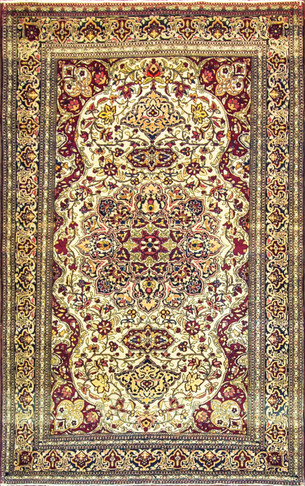
The Iranian city of Isfahan has long been one of the centres for production of the famous Persian carpet. Isfahani carpets are known for their high quality. The most famous workshop in Isfahan is Seirafian. Weaving in Isfahan flourished in the Safavid era. But when the Afghans invaded Iran, ending the Safavid dynasty, the craft also became stagnant. The high knot density antique carpets in which Isfahan excelled continued to be woven in the late 19th and 20th centuries, maintaining the original inspiration and attention to refinement and detail.
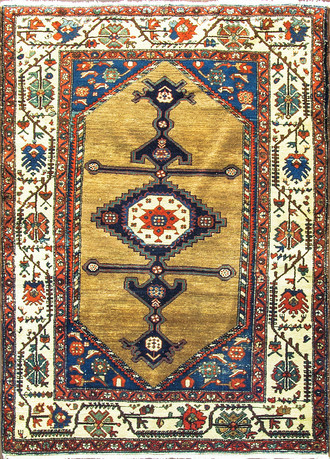
The Caucasus is bounded by the rugged mountains and lush valleys of Armenia, Azerbaijan and Georgia. This cultural melting pot was populated by Armenian dyers and weavers, Azeri Turks, groups from the Northern Caucasus and minorities from the surrounding areas. The Kazak rugs of the Caucasus are distinctive and individual. Geometric people and animals, symbolic motifs, dramatic medallions, crenelated fence borders, angular cloud-bands and graphic latch hook
Colorful and dramatic Kilims (kelims) were produced by both villagers and tribal nomads in Persia. Slit tapestry predominated among Azerbaijani, Shahsevan and Ghashghai weavers, while some Kurds and others in western Persia used interlocked tapestry. These all typically have clear coloring and bold patterns.
The material probably, made from Llama wool fibers (South American camel), is woven with unique technique, designs and drawings which are taken from Asian and Middle East kilims. These kilims also used as coverlets .
From point of quality view, Lama’s fibers are finer and tinier than sheep wools . They are not smeared with any kind of wool fat (lanolin-existing animal fat on the sheep skins).
The technique in Peruvian Kilims is using pairs and parallel warps and weft . Its designs and drawings are created by weaving the colored woofs between cream colored wraps.
The district of Shirvan produced many highly decorative antique rugs that have complexity that is found in few rugs from the Caucasus. Shirvan, which is part of modern-day Azerbaijan, was populated by Azeri Turks and some Armenians, who were expert dyers and weavers.
Grand symbol-filled medallions with polychrome accents are featured prominently as are all-over Afshan patterns, which are a sort of angular arabesque filled with dramatic harshang palmettes. Stunning allover patterns featuring symbolic devices and a latticework of angular floral sprigs are also used.
A subtype of the Kuba rug, antique Seychour (also known as Seichur and Zeychour) rugs are made in the small town of Yukhari-Zeykhur in Azerbaijan in the Northeast Caucasus. Known for the detailed precision of their drawing and design as well as for their saturated colors, antique Seychour rugs popularly display designs such as cabbage rose, tulips and the Seychour cross. Differing from other Caucasian rugs, antique Seychour rugs do not share the same symmetry in their borders.
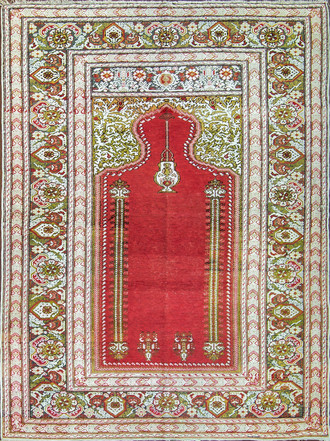
Antique Silk Turkish Rug, Turkey, Early 20th Century -- This outstanding Silk Turkish Rug reflects incredible care and attention to fine detail in its design and composition. Red, Brilliant green, yellow, , ivory colors permeate the visual imagery.associated with prayer, perhaps signifying the interconnections of life, scrolls throughout the border. Two elegant decorative guard borders set against ivory background present brilliantly colored red and green scrolling motifs.
This rug originally purchased from an nice estate in Park Ridge suburb of Chicago and was hanging on the wall