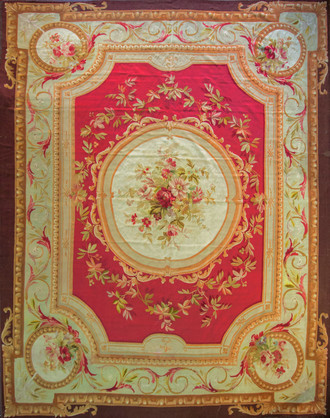
Antique French Aubusson carpet, one of the finest tapestry, 19th century in excellent condition.
Purchased from estate of Richard and Diane Fisher collection and reputed from estate of Jenny Lind.
Jenny Lind Swedish Opera singer (6 October 1820 – 2 November 1887) One of the most highly regarded singers of the 19th century.
Tapestry manufacture at Aubusson and in the upper valley of the Creuse in central France.
They have developed from looms in isolated family workshops established by Flemings that are noted in documents from the 16th century.
The town of Felletin is identified as the sou
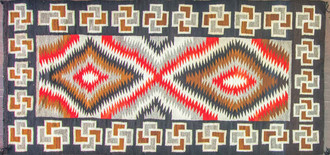
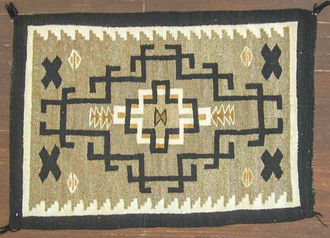
The weavers preferred to use natural wool from their sheep rather than the commercially produced wool used by other Navajo weavers. After the wool was carded together it was spun very fine, sometimes even as fine as thread. These threads allowed the weavers to weave more wefts to the linear inch, which created a textile of a much higher quality than other Navajo weavings.
The weavers preferred to use natural wool from their sheep rather than the commercially produced wool used by other Navajo weavers. After the wool was carded together it was spun very fine, sometimes even as fine as thread. These threads allowed the weavers to weave more wefts to the linear inch, which created a textile of a much higher quality than other Navajo weavings.
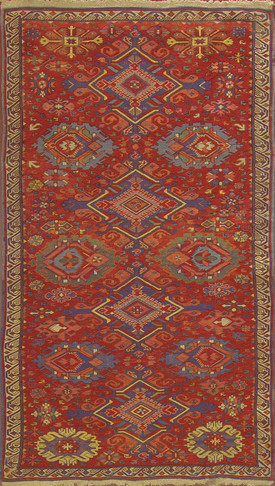
Antique Caucasian Soumak (Sumak) Kilim
Size: 3'5" x 6'1"
Origin: Caucasus (likely Shirvan / Kuba region influence)
Date: Circa late 19th.
Structure: Flatweave Soumak technique, wool on wool.
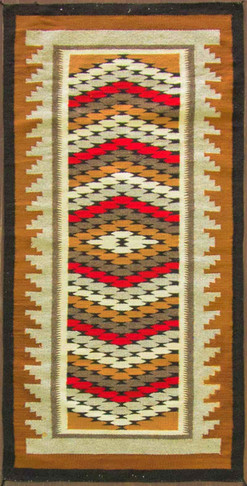
This is an exceptionally fine and visually striking antique Caucasian Soumak kilim, distinguished by its richly saturated color palette and highly articulated tribal drawing.
The field is dominated by a deep madder red ground, a hallmark of desirable Caucasian weavings, providing a warm and powerful visual foundation.
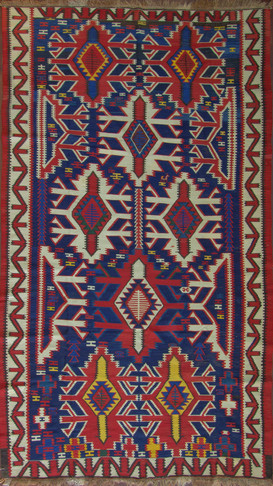
Antique Kilim long carpet, Kuba, late 19th century. An impressive staggered design of serrated palmette set against a blue field on this magnificent antique Kuba Kilim or great classical carpets of the Caucasus. The smaller palmettes and rosettes that make up the border also reflect the Kazak and Karabagh rugs of the Caucasus. Kilims with such design and rich color are exceptional in Persian weaving, as is the unusually long and large format of this amazing piece.
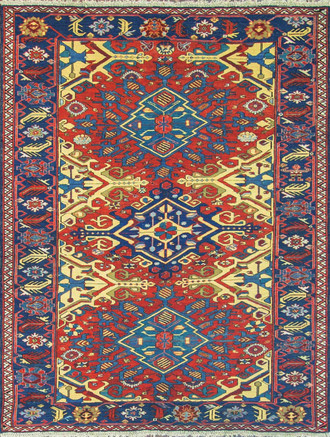
Precise drawing applied to highly abstract or stylized geometric patterns, using a rich and varied palette.
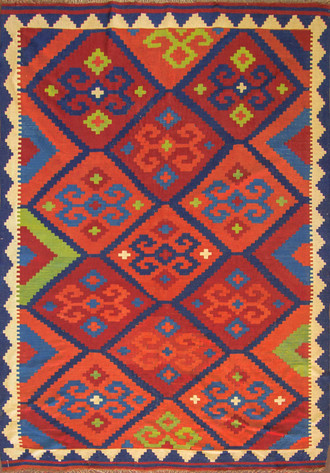
Soumaks are flat woven rugs. Their technique is related to that of Kilims, but it is somewhat more complex.
It is more durable as floor covering. As opposed to Kilim technique which consists of compacted weft facing simply running over and under the vertical wraps, Soumak weave runs the yarns around the warps in a serpentine pattern, over two, back one, over two back one, and so forth.
The design large polygonal medallions, often in the shape of diamonds or stars.
The weavings of Azerbaijan are prized by collectors for their technical perfection and utmost emotionality.
Azerbaijani rugs are a product of Azerbaijan and Iranian Azerbaijan, an ancient center of carpet weaving. The Azerbaijani rug is a traditional handmade textile of various sizes, with dense texture and a pile or pile-less surface, whose patterns are characteristic of Azerbaijan's many carpet-making regions.