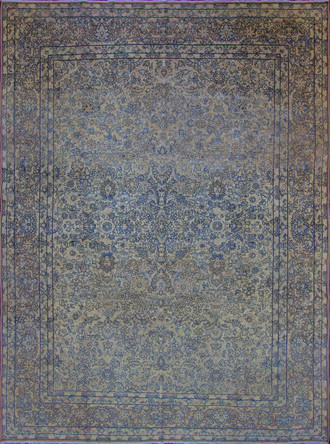
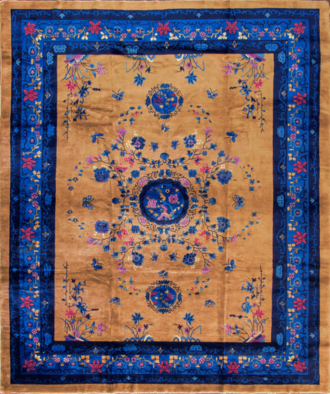
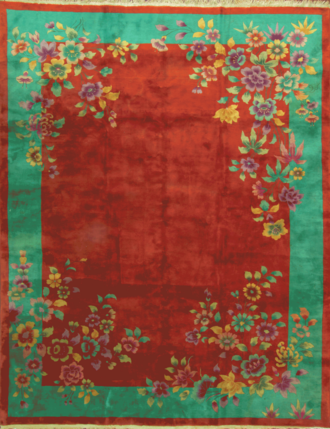
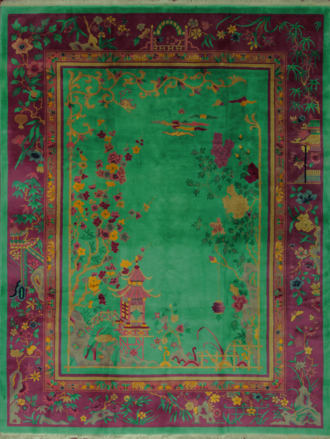
To the south east of Persia is the city of Kerman or Kirman and to the north of Kerman is the village of Laver or Raver which has a rug weaving history at least as long as that of Kerman. during the 1920s produce many rugs for the US market but the rugs been produce in this region since the sixteen century.
Great vegetable dyed silky soft wool pile over cotton warp and wool weft foundation.
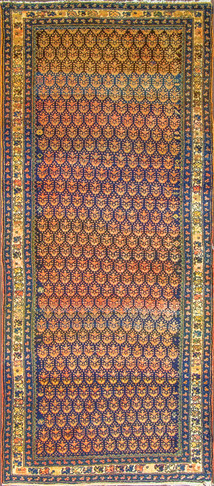
The design contain allot of detail. Looking at the carpet from one direction you will notice birds feeding their chicks in their nest and from the opposite direction you will notice the Botteh design.
The rug's color shades change throughout the rug.This affect is better known as Abrash.
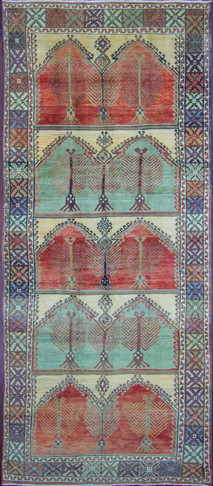
Charming muted colors Oushak carpet with the unidirectional shapes.
Ushak rugs have been in production since the 15th century with superb wools and natural dyes. Unlike other Turkish rugs, Ushak rugs influenced after Persian rugs and they woven with Ghiordies knots and all double knotted, their design is feature intricate motifs of vines and leaves and typically based on geometric motifs.
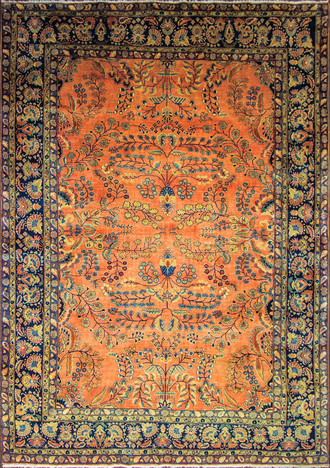
Antique Persian Mohajeran Sarouk, c-1910, the rug has very high density of knotting and it is made of fine manchester wool.
The floral design of the rug has a pleasant appeal because the field is field is very open.
The combination of colors are very appealing.
Sarouk, a small village and its neighboring villages in northwestern Iran are the source of large numbers rugs imported into the United States. The Sarouk carpet production came into existence around 1880 specifically for the European and North American markets.
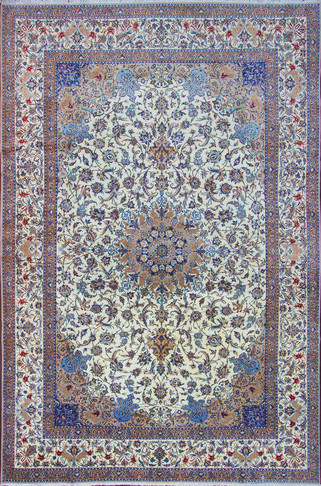
Nain rugs are constructed with Persian knot and typically have between 300 and 700 knots per inch,usually are with very high quality wool, clipped short, and silk is often used as highlighting for detail in the design. Nains utilize the Shah Abbas design and make use of flowing design such as flowers and tendrils.
The most famous and influential Nain masterweaver is Habibian and Reza Jafari Naini.