"Timeless Elegance: The Allure of Oushak Rugs from Western Turkey"
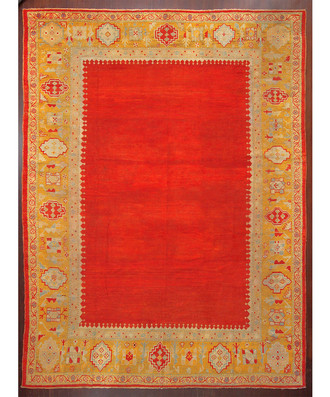
Oushak rugs, originating from the historic region of Oushak in western Turkey, boast a rich heritage steeped in centuries of rug weaving craftsmanship. Renowned for their exceptional quality and distinctive designs, Oushak rugs have become a symbol of timeless beauty.
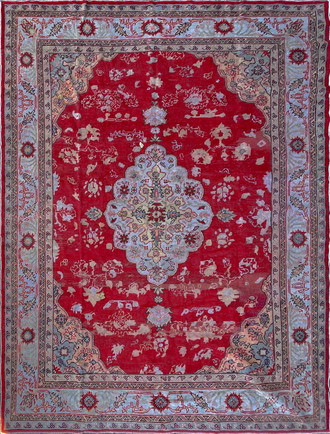
One of the distinguishing features of Oushak rugs is their unique color palette, characterized by soft, inviting hues. The designs often revolve around a central medallion, complemented by intricate floral motifs and geometric patterns.
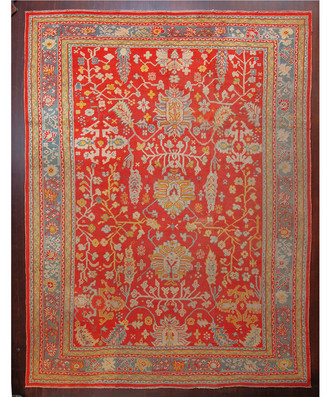
Ushak rugs have been in production since the 15th century with superb wools and natural dyes. Unlike other Turkish rugs, Ushak rugs influenced after Persian rugs and they woven with Ghiordies knots and all double knotted, their design is feature intricate motifs of vines and leaves and typically based on geometric motifs.
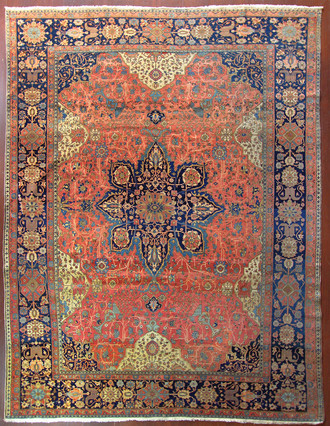
Introducing the exquisite Sarouk Feraghan, a timeless rug dating back to the late 1880s and remarkably preserved in excellent condition.
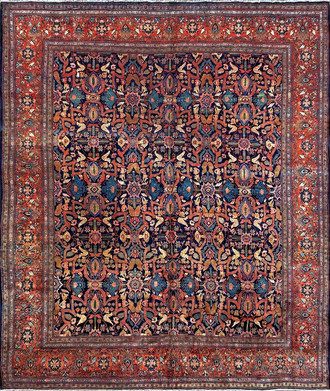
Woven in and around the picturesque region of Arak in northwest Iran, this rug boasts a captivating allover design. The artistry within features a harmonious blend of suave curve-linearity, geometric styles, and enchanting depictions of birds. Notably, the Farahan Sarouk rugs exhibit a unique combination of angular drawing akin to Herizes and Serapis, albeit on a much finer scale suitable for classical designs.
Ushak rugs have been in production since the 15th century with superb wools and natural dyes. Unlike other Turkish rugs, Ushak rugs influenced after Persian rugs and they woven with Ghiordies knots and all double knotted, their design is feature intricate motifs of vines and leaves and typically based on geometric motifs.
One of the sign of original Mohtasham rug which named "Mohtasham Father" and also showing in this particular rug is the silk edge rapping. Other indications are the fine weave and fine short cut pile, also the special magnificent colors.
. “Mohtasham Father “ refers to Kashan rugs made from c.1882 until 1914 woven in a particular atelier with a specific quality wool like English and Australian Merino wool, made by Hajji Mollah Hassan Mohtasham and his skilled weaver.
These rugs had a velvety short pile and tight knotting.
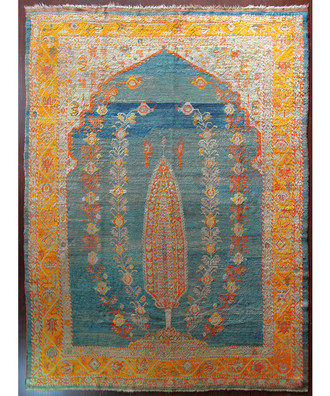
The special significant of this amazing rug is the beauty of the design which features plants and three in water, sea or ocean, also the blue background color is features sea water. The softens of angora wool complicating the spectacular charm of this Ushak carpet.
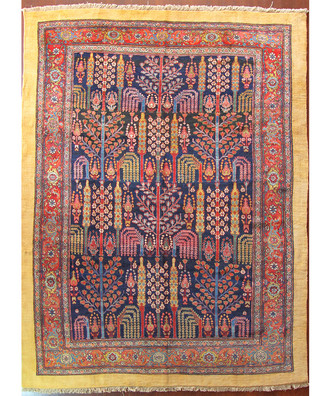
A tree of life Bijar carpet is describe a tall tree which is believed to have grown out of the center of the world, living for centuries, knowing the secrets of the world, and being close to the universal powers. It is a tree, which is regarded as the stairs of human journey from the underground to the sky, its knots grasping the world and its branches hosting the birds of Paradise. Denoting life. This tree to envoy endless happiness.
Bidjar is a town in Persian Kurdistan and the production of rugs made mostly in weavers home and not in the work shop.
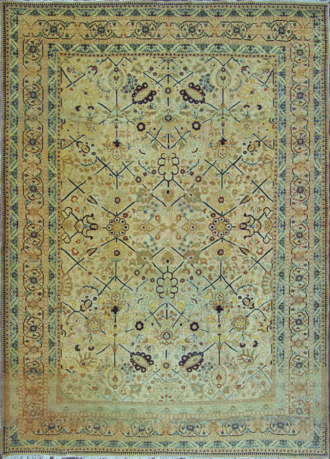
A very fine late 19th-century Persian Tabriz carpet attributed to the celebrated Hajji Jalili tradition, distinguished by its exceptionally delicate drawing, sophisticated floral composition, and beautifully subdued palette.
The open ivory field is particularly attractive and is filled with an elaborate network of flowering vines, palmettes, rosettes, leaves, and graceful arabesques. Rather than relying on a dominant central medallion, the design develops rhythmically across the entire field, giving the carpet an unusually spacious and elegant appearance.