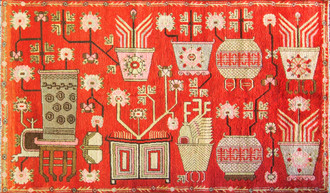
Khotan, an ancient Buddhist kingdom, was located on a branch of the famous Silk Road in Eastern Turkestan, in what is modern-day Xinjiang, China. Carpets from this region, though made in the cities of Kashgar and Yarkand as well as Khotan, are often called Samarkand rugs, after the name of the Uzbek city on the Silk Road that served as a major commercial hub for the sale and export of textiles. The tradition of rug weaving in this region goes back to around the 3rd century, although most of the surviving examples date from the 19th and 20th centuries.
The most wonderful color combination which bring a dramatic look the whole carpet. The design and condition of the rug are impeccable.
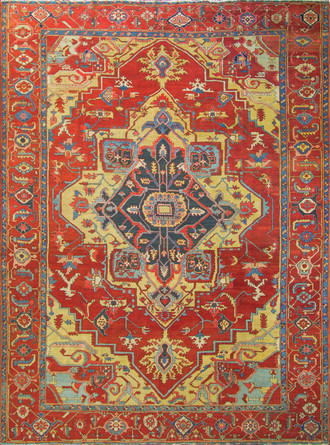
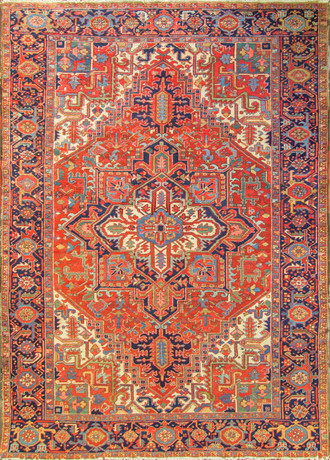
This remarkable and artistic antique rug, showcases an ornate, multicolored central design. At the heart of the antique Persian Heriz Serapi rug, a many-petaled flower is surrounded by a twelve-pointed stellar shape in light and dark blue and yellow. Angular stylized flowers stud the navy form and are echoed across the red medallion that encases it. Four ornaments decorate the corners of the medallion, and floral adornments nestle within each tip.
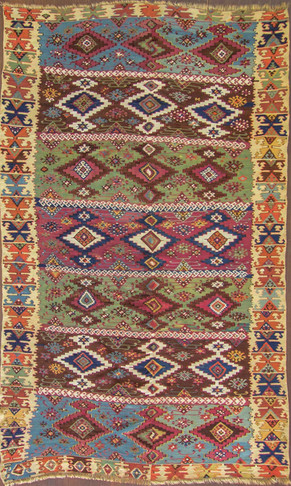
It is from the group of Konya called Nigde-Adana.
It has geometric pattern both in the field and the border.
This Kilim made of two sections.
One of oldest that I have seen according the colors.
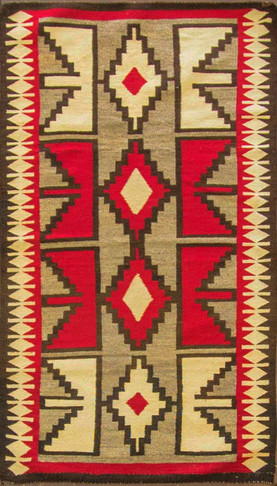
A typical Navajo rug has approximately 30 wefts to the linear inch. The finer pieces frequently have upwards of 80. When a textile has 80 or more wefts per inch, it is considered a tapestry, not a rug. The most famous weaver of these textiles was Daisy Taugelchee (1909-1990), who wove upwards of 115 wefts per inch, which created the most finely woven Navajo tapestries anywhere.
The weavers preferred to use natural wool from their sheep rather than the commercially produced wool used by other Navajo weavers.
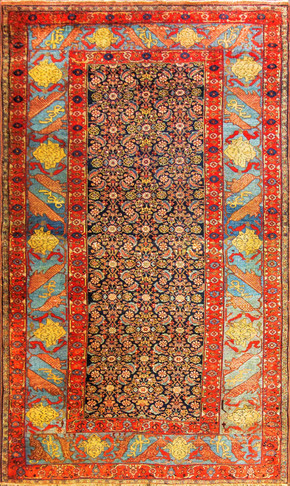
A dynamic and exciting composition, this gorgeous late 19th century Bidjar runner from the 1880s showcases some of the finer qualities exhibited by the Persian iron rug of Iran. This antique Bijar is a historical rug woven in the village of Halwai, North-East of Bijar. This Halwai Persian Bidjar is immersed in Persian culture and reflects first-class prestige, a true collector’s piece. This beautifully detailed Persian Bijar boasts an ornate elaborate all-over pattern, rendered in exquisite detail. The intricate finials seem to float majestically within its abashed red open field.
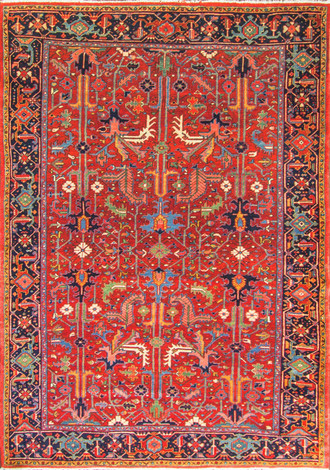
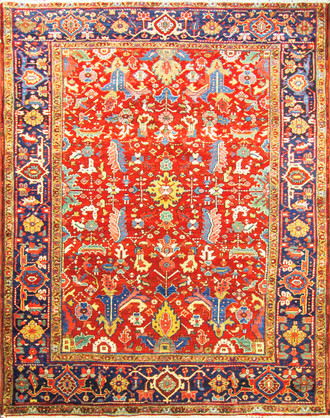
A great painting is measure by beauty of its colors and the same statement goes for this rug. Heriz rugs are Persian rugs from the area of Heriz, East Azerbaijan in Northwest Iran, Northeast of Tabriz. Such rugs are produced in the village of the same name in the slopes of Mount Sabalan. Heriz carpets are durable and hard-wearing and they can last for generations, 19th century examples of such carpets are often found on sale by major auction houses in United States and Europe.
A great painting is measure by beauty of its colors and the same statement goes for this rug. Heriz rugs are Persian rugs from the area of Heris, East Azerbaijan in northwest Iran, northeast of Tabriz. Such rugs are produced in the village of the same name in the slopes of Mount Sabalan. Heriz carpets are durable and hard-wearing and they can last for generations, 19th century examples of such carpets are often found on sale by major auction houses in United States and Europe.
Antique Persian Heriz rug, Persia, circa 1920. This remarkable and artistic antique rug, showcases an ornate, multicolored central design. At the heart of the antique Persian Heriz Serapi rug, a many-petaled flower is surrounded by a 12-pointed stellar shape in light and dark blue. Angular stylized flowers stud the navy form and are echoed across the red medallion that encases it. Four ornaments decorate the corners of the medallion, and floral adornments nestle within each tip. A rust red field, brimming with botanical decorations, extends the medallion’s shape.