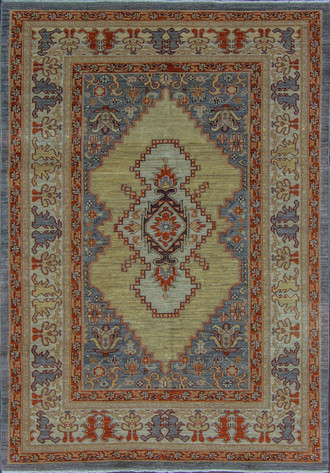
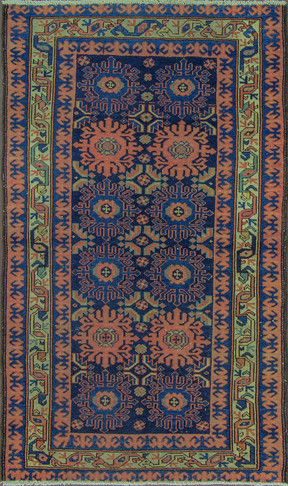
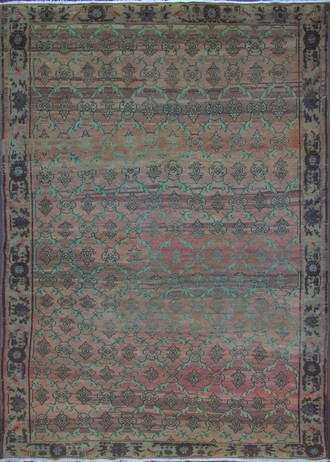
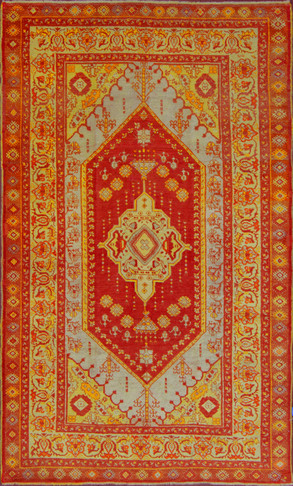
Ushak rugs have been in production since the 15th century with superb wools and natural dyes. Unlike other Turkish rugs, Ushak rugs influenced after Persian rugs and they woven with Ghiordies knots and all double knotted, their design is feature intricate motifs of vines and leaves and typically based on geometric motifs.
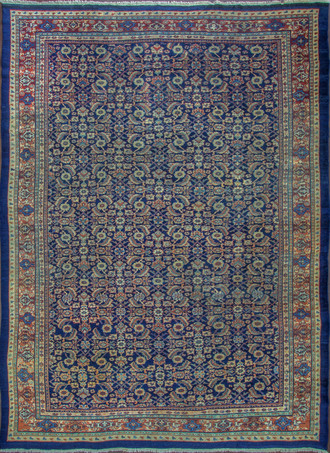
The city of Sultanabad (now known as Arak) was founded in 1808 to become the major center of rug production in Iran.[1] Sultanabad carpets are distinguished as the highest quality of Mahal productions manufactured in the Arak region. Other types of Sultanabad designs may include production from Mushkabad. Farahans and Sarouks were also made in the Arak region, though are wholly different.[2]
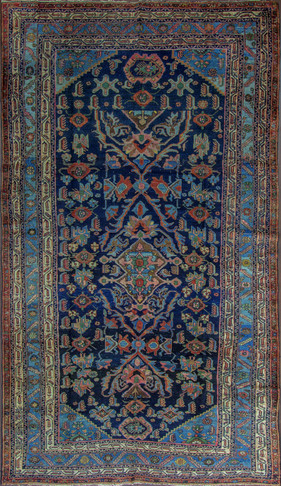
A Persian Malayer carpet, made in the village in northwest Persia before 1920th. the design is unusual geometric motives. It made with vegetable dyes wool pile on cotton foundation.
The tribal weavers in Malayer were often Turkish, and they employed the Turkish knot, Gourde, to weave these creations. The Gourde is a symmetrical knot, as opposed to the asymmetrical knot of many traditionally Persian creations. Additionally, antique Malayer rugs regularly enjoy a low cut pile. Weavers trimmed the pile in order to enhance the appearance of the design.
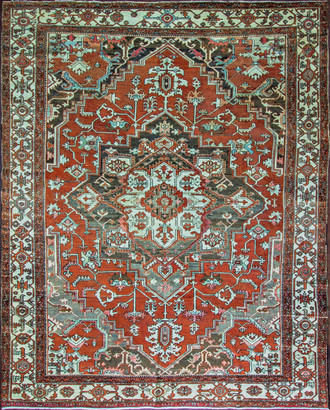
Serapi rugs are to all intents and purposes a particular type or grade of what are called Heriz rugs - more specifically the highest grade in terms of weave, and very probably the oldest type in terms of age. Heriz carpets are generally coarsely woven. Since the early twentieth century they have come to make use of light blue cotton wefting. Serapis, in contrast, have a higher knot count, sometimes attaining 80 knots per square inch. Their backs are relatively flat, and they have ivory cotton wefting.
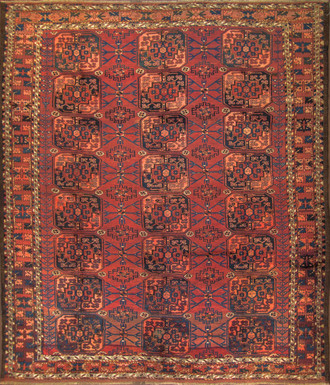
The Ersari Tribe includes the Beshir, Charshango and Kizil Ayak as sub groups. The Ersari tribe and other Turkoman groups began moving into the north-eastern Afghanistan from early seventeenth century and they continued their weaving craft. Most rugs from that area till the 20th century where made by Turkomans and Baiuchi tribes and not by Afghans and it is appropriate labelled as "Ersari Afghan".
The Ersaris used undyed weft which is visible along its entire length is a characteristic feature.