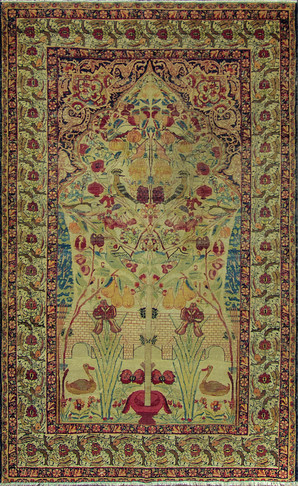
Striking Antique Kermanshah rug, c-1880. Pictural scene of three of life surrounded with birds and fish trees and plants.
The rug has a very fine weave and pleasant colors.
Kirman was a very important antique rug weaving center dating from the Golden Age of Persian culture under the Safavid Dynasty in the 16th century, on a par with Tabriz and Kashan in esteem. The color palette of Laver Kirman antique Persian rugs is unusually soft and delicate with a European grace.
These rugs are very heavy in relation to their size and sturdy and sometimes impossible to fold them because of their knotting technique. The material is wool knotted on wool foundation and the wool dyed with vegetable colors.
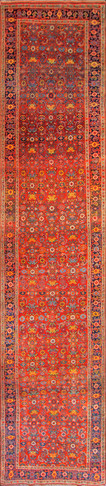
This rug made in northwestern Persia in the Kurdish village and the pattern is herati also called the mahi flower consists of a rosette enclosed in a diamond with curved leaves and small flowers. This runner has allover Herati Pattern and the Herati symbol is auspicious, and is often thought to bring good luck.
Mohajeran Gazan Carpet:
One of the top high end Persian carpet Maker.
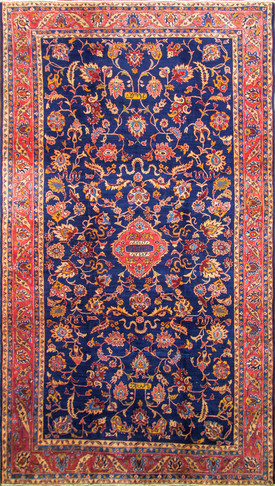
The source of this important provenance has been in the village of Sarouk. North of Arak (formerly Sultanabad). Sarouks are known to be of high quality. The pile is usually higher than the average Persian rug and therefore Sarouks are rather heavy and solid rugs, the wool being used is high quality durable wool. "Mohajeran" or "Mahajiran" is the name of a village West of Arak.
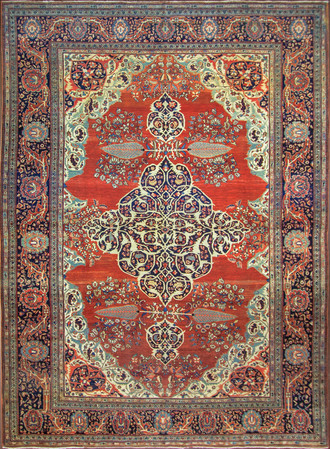
Feraghans were made between the 1870s and 1913 from a region north of the town of Arak, produced for the Persian aristocracy. They are single wefted, long and narrow or room-sized carpets, typically with an allover herati design or floral and curling leaf motifs. Feraghan-Sarouks, also called Sarouks, are double-wefted, heavier carpets with a higher knot count than village Sultanabads. Fields are often blue or ivory and designs typically feature either large medallions or representations of trees and birds
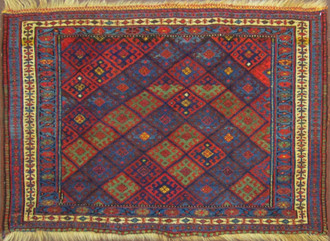
Of large size, this finely woven Kurdish bag face from northwest Persia is a very collectable example of a well known format. It features the classic diamond design that is composed in an unusually sophisticated manner. It features a wide range of natural dye colors, including sky blue, light and deep coral and two shades of green. It retains the skirt and part of the end finish at the bottom and the much of the end finish at the top. The checkerboard outer guard border is a charming additional feature.
To the south east of Persia is the city of Kerman or Kirman and to the north of Kerman is the village of Laver or Raver which has a rug weaving history at least as long as that of Kerman. During the 1920s produce many rugs for the US market but the rug's been produced in this region since the 16th century.
Sarouk (also Saruk or Sarough) rugs are those woven in the village of Saruk and also the city of Arak, Iran and the surrounding countryside. Sarouk rugs have been produced for much of the last century. The early successes of the Sarouk rug are largely owed to the American market. From the 1910s to 1950s, the “American Sarouk” also known as the “Painted Sarouk” was produced. American customers had an affinity for the Sarouk’s curvilinear and floral designs
Fine and soft shiny Persian wool woven into beautiful runner over sixty five years ago with a combination of cream blue green and red all postal colors and they are all from vegetable dyes.
To the south east of Persia is the city of Kerman or Kirman and to the north of Kerman is the village of Laver or Raver which has a rug weaving history at least as long as that of Kerman. During the 1920s produce many rugs for the US market but the rug's been produced in this region since the 16th century.