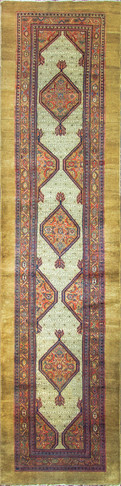
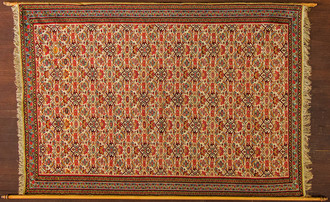
In the province of Azerbaijan in northwestern Iran, the village of Sarab served as the name source for antique Sarab rugs and it is located in northwest Iran in the province of Azerbaijan and they known for their fine long rugs or runners with a characteristic camel ground and lozenge-shaped medallions.
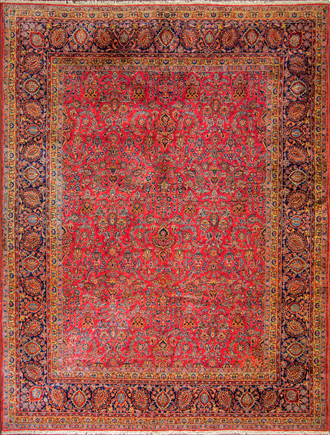
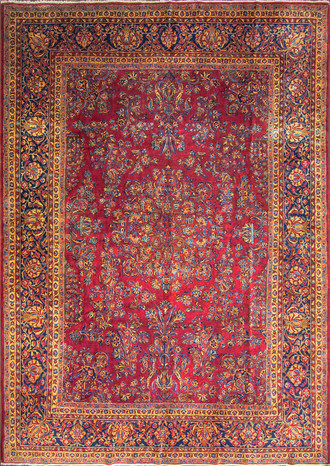
A Kashan rug made in Persia in the city of Kashan in Isfahan Province North Central Iran. There was production of Persian carpet at Royal workshops in the 17th and early 18th century. The Persian carpet workshops ceased production in about 1722 after the Afghan invasion. Persian carpet production was very minor until the 20th century. Historically, Kashan was a major center in the garment trade. In the late 19th century, the market shifted and the local industry went from fine wool cloth to fine wool carpets. High quality wool was sourced from Sabzevar.
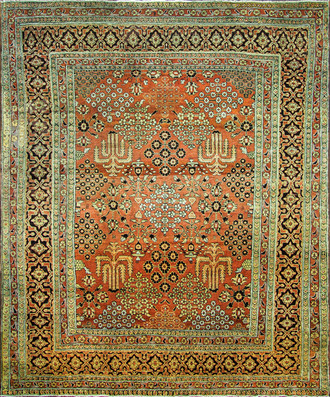
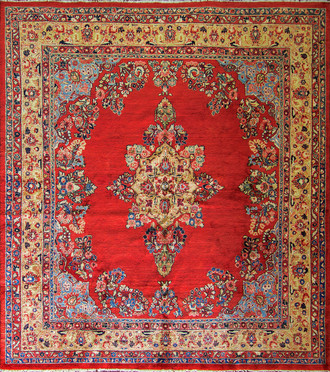
The city of Sultanabad (which is now known as Arak) was founded, in the early 1800s, as a center for commercial rug production in Iran. During the late 19th century, the firm of Hotz and Son and Ziegler and Co. established a manufacturer in Arak / Sultanabad whose sole objective was to produce rugs to meet the western demands.
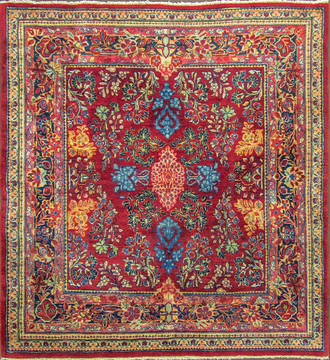
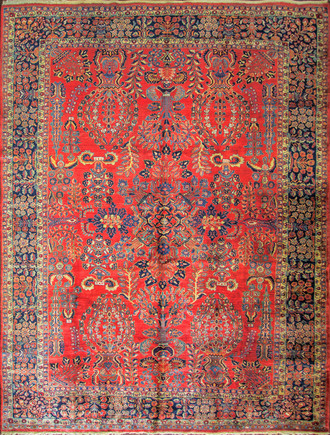
The source of this important provenance has been in the village of Sarouk. North of Arak (formerly Sultanabad). Sarouks are known to be of high quality. The pile is usually higher than the average Persian rug and therefore Sarouks are rather heavy and solid rugs, the wool being used is high quality durable wool. "Mohajeran" or "Mahajiran" is the name of a village West of Arak.
Senneh Rugs, produced in Northwest Persia, are prized for their fine, delicate design and their distinctive, weaving technique. Senneh come in a range all-over and medallion patterns, and consequently it is their weave rather than their design that sets them apart. But whatever their design, Senneh rugs and carpets always display a precise, crisp somewhat geometric drawing that corresponds to the precision of the weave. Colors tend to be varied and rich, but soft as well.
A Kashan rug made in Persia in the city of Kashan in Isfahan Province North Central Iran. There was production of Persian carpet at Royal workshops in the 17th and early 18th century. The Persian carpet workshops ceased production in about 1722 after the Afghan invasion. Persian carpet production was very minor until the 20th century. Historically, Kashan was a major center in the garment trade. In the late 19th century, the market shifted and the local industry went from fine wool cloth to fine wool carpets. High quality wool was sourced from Sabzevar.
The source of this important provenance has been in the village of Sarouk. North of Arak (formerly Sultanabad). Sarouks are known to be of high quality. The pile is usually higher than the average Persian rug and therefore Sarouks are rather heavy and solid rugs, the wool being used is high quality durable wool. "Mohajeran" or "Mahajeran" is the name of a village West of Arak.
Sarouk, a small village and its neighboring villages in northwestern Iran are the source of large numbers rugs imported into the United States. The Sarouk carpet production came into existence around 1880 specifically for the European and North American markets.