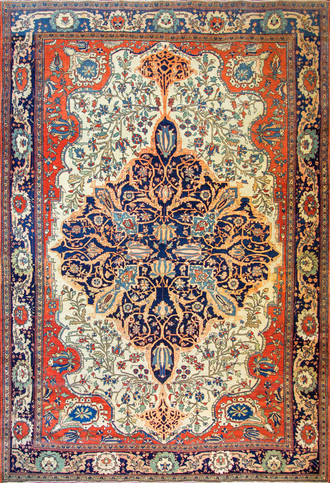
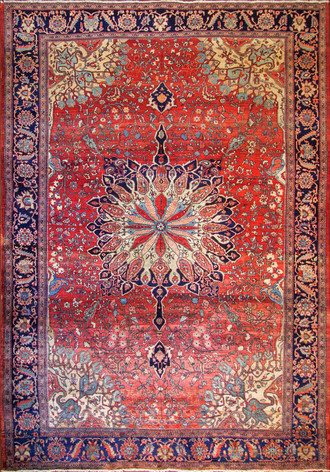
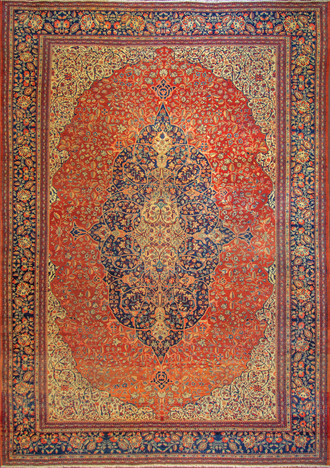
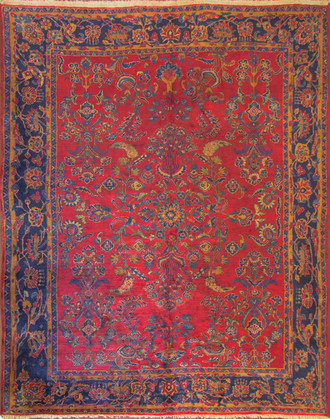
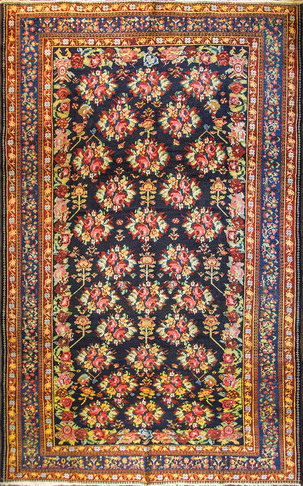
This exceptional antique Persian Sarouk Feraghan carpet is a distinguished late-19th-century weaving from the renowned Feraghan district, an area celebrated for producing some of Persia's finest decorative and collector-quality carpets. Woven before 1880, it displays the elegant balance of refined village craftsmanship and sophisticated workshop design that has made Feraghan carpets among the most sought-after antique Persian rugs.
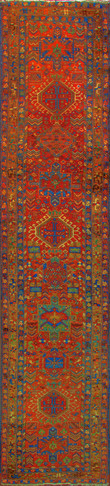
Feraghans were made between the 1870s and 1913 from a region north of the town of Arak, produced for the Persian aristocracy. They are single wefted, long and narrow or room-sized carpets, typically with an allover herati design or floral and curling leaf motifs. Feraghan-Sarouks, also called Sarouks, are double-wefted, heavier carpets with a higher knot count than village Sultanabads. Fields are often blue or ivory and designs typically feature either large medallions or representations of trees and birds
This elegant late-19th-century Persian Sarouk Feraghan carpet is a superb example of one of the most respected weaving traditions of Central Persia. Woven around 1880, it displays the refined artistry that distinguishes early Feraghan carpets from later commercial Sarouks. These carpets are admired for their fine weave, durable hand-spun wool, harmonious vegetable dyes, and graceful blend of village character with sophisticated workshop design.
The carpet is centered by an impressive elongated navy-blue medallion with an ivory centerpiece, resting on a rich terracotta-red field.
Sarouk, a small village and its neighboring villages in northwestern Iran are the source of large numbers rugs imported into the United States. The Sarouk carpet production came into existence around 1880 specifically for the European and North American markets. Before 1920s the Sarouk design was similar to that of the rug weaving centers of Ferahan and Tabriz. Most Sarouk rugs followed a very distinctive design and it depended on floral sprays and bouquets.
Mohajeran refers to another village where rugs are produced.
This beautiful antique Persian Bakhtiari carpet is a fine example of the distinctive village weaving tradition of the Bakhtiari tribes of southwestern Persia. Woven around 1920, it displays the superior craftsmanship, durable construction, and lustrous hand-spun wool that have made antique Bakhtiari carpets highly respected among collectors and decorators.
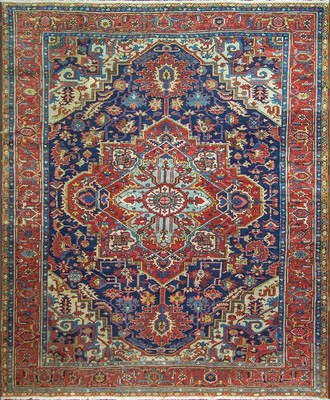
This exceptional late 19th-century Serapi carpet represents one of the most admired village weaving traditions of Northwest Persia. Distinguished by its bold architectural drawing and refined craftsmanship, the carpet features a commanding geometric medallion set against a rich midnight-blue field, framed by ivory corner spandrels and a beautifully proportioned coral-red border.
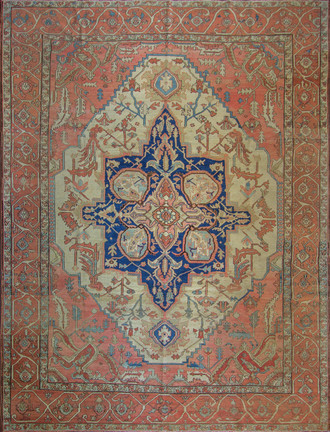
A handsome and highly decorative late 19th-century Persian Serapi carpet, circa 1880, distinguished by its spacious drawing, strong architectural medallion, and beautifully softened natural color palette.
The composition is centered by a dramatic deep indigo-blue geometric medallion, surrounded by an expansive ivory ground and framed by warm salmon, coral, and terracotta tones.