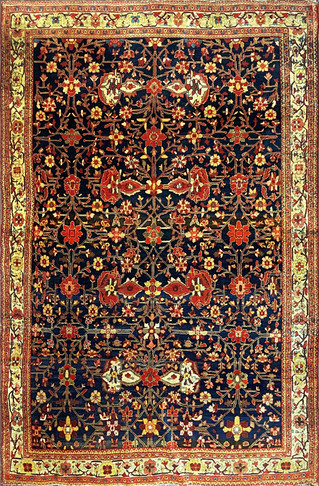
This exceptional late-19th century Persian Feraghan is an outstanding example of the finest weaving produced in the Feraghan district during the golden age of Persian carpet making. Woven circa 1870, the rug displays an elegant all-over lattice of flowering vines, palmettes, and stylized botanical motifs set against a rich midnight navy field.
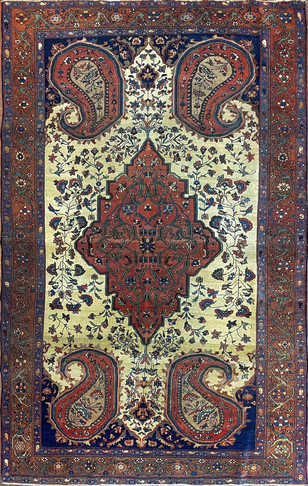
This exceptional antique Persian Sarouk-Farahan (Feraghan) carpet, dating to circa 1870 or before, represents the pinnacle of 19th-century tribal-court weaving. Crafted during the celebrated "pre-commercial" era, it embodies an artistic purity and meticulous craftsmanship reserved for the Persian aristocracy rather than the Western export market.
The Ivory Field & Medallion: At the heart of the carpet lies an open, luminous ivory field, which beautifully highlights a sharply stepped, elongated central medallion.
An exceptional antique Persian Manchester Wool Kashan Vase Rug, handwoven circa 1920, representing the finest artistic traditions of Kashan during the early twentieth century. This elegant rug is woven with the highly prized Manchester wool imported from England, renowned for its extraordinary softness, silky luster, and durability.
An exquisite antique Persian Kashan rug, handwoven around 1920 using the highly prized Manchester wool imported from England. During the late 19th and early 20th centuries, the finest Kashan workshops selected Manchester wool for its exceptional softness, strength, and luxurious sheen, producing some of the most elegant Persian rugs ever woven.
This beautiful example features a luminous rose-pink field centered by an elegant sky-blue floral medallion surrounded by finely drawn arabesques, palmettes, and delicate flowering vines.
A beautiful antique Persian Bidjar dating to approximately 1920, handwoven with the exceptional craftsmanship that has earned Bidjar rugs the reputation as the "Iron Rugs of Persia." Renowned for their incredibly dense weave and outstanding durability, Bidjar rugs are among the most structurally robust Persian carpets ever produced.
This example features a rich deep terracotta-red field adorned with an intricate allover Herati (Mahi) pattern, centered by a striking ivory and navy medallion.
An exceptional antique Persian Mohajeran Sarouk dating to approximately 1910, masterfully woven with a magnificent Tree of Life design. The luminous salmon-rose field provides a striking backdrop for an elegantly drawn flowering cypress rising gracefully from the base of the rug, symbolizing life, immortality, and spiritual renewal.
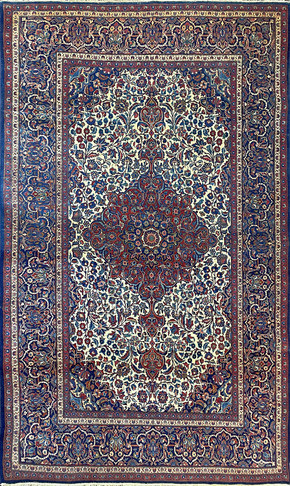
A beautiful antique Persian Dabir Kashan, handwoven around 1920, featuring an elegant ivory field adorned with intricate scrolling floral vines surrounding a richly ornamented medallion. The deep navy border is filled with finely detailed palmettes and arabesques that beautifully frame the composition. Woven with high-quality wool on a cotton foundation, this rug exhibits the fine weave, refined drawing, and balanced color palette that distinguish the celebrated Dabir workshop.
Foundation: Cotton foundation with exceptionally fine wool pile
Colors: Deep midnight blue, ivory, salmon, rose, terracotta, soft gold, and delicate sky-blue accents
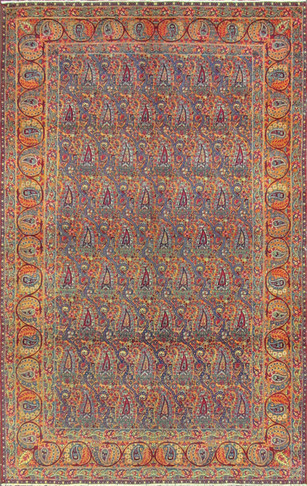
This is a beautiful antique Persian Laver Kerman rug dating from the early 20th century, woven during the finest period of Kerman production. The rug exhibits the remarkable elegance, refinement, and artistic sophistication that have made Laver Kermans among the most highly regarded Persian carpets.
The field is covered with an allover boteh (paisley) design arranged in orderly rows across a rich midnight-blue ground.