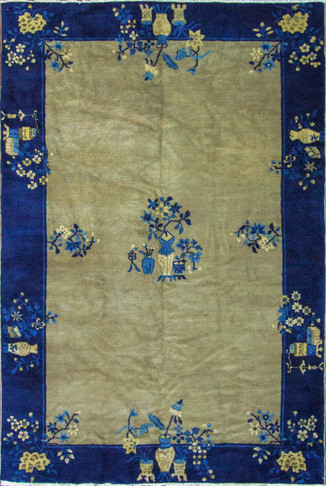
Discover the rich history of Antique Peking Rugs, a tradition that found its roots in China shortly after the conclusion of the First World War. During this era, Chinese rug weaving factories underwent a significant shift, relocating from regions like Ningxia to the heart of China, the capital city of Peking.
Peking rugs retained elements of traditional patterns inherited from Ningxia production, but they also began to evolve. At times, the designs became simpler and more asymmetrical, reflecting modern Western Art Deco influences.
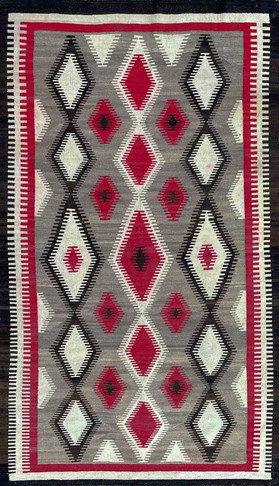
Embark on a journey into the past with our rare and captivating Antique Navajo Rug, a magnificent textile masterpiece that captures the essence of history and craftsmanship. Dating back to the 1920s-1930s, this rug is a testament to the skill and artistry of the Navajo people.
With its massive dimensions measuring 50 by 92 inches, this Navajo weaving is a true marvel. What sets it apart is its unique whitish tan background, a departure from the traditional grey, achieved through the use of natural-colored yarns.
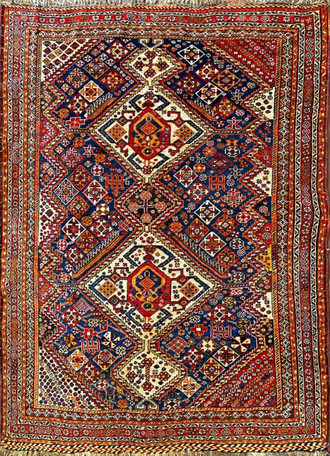
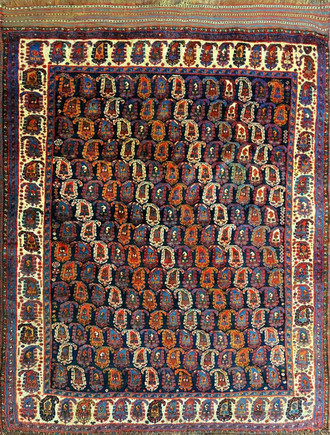
This exceptional late 19th-century Persian Qashqai rug is a superb example of tribal artistry, woven around 1890 with remarkable precision and outstanding decorative appeal.
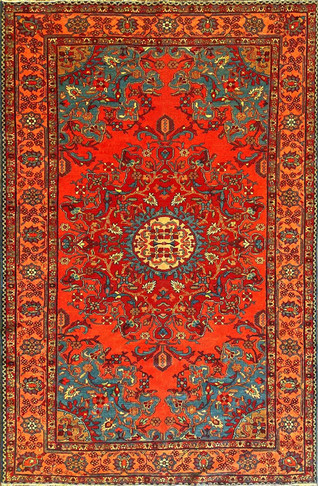
Beautiful colors with fine quality, circa 1920. Handwoven Lilihan rug. Produced south of the city of Arak by Armenians in Persia, Lilihan rugs are known for their design. Traditionally designed with a curvilinear lattice with traditional floral motifs these rugs also feature geometric designs. The primary characteristic of Lilihan rugs is the abundant use of pink although khaki and brown ornament the salamander background. Made with a good pile, these rugs are often mid-sized.
Measures:5'6" x 7'2". Amazing Qashqai rug, wool on wool natural dyed wool.
Beautiful multi-colors with geometric motif design.
It has unusual size The Ghashghai nomads are found in the far province in the southwest of Iran. They move twice a year, between the winter pasture near the Persian Gulf and the summer pasture up in the Zagros mountains where it is much cooler. The carpets have a typical red-brown ground color. The pattern is tied from memory and often consists of a centrally placed medallion, repeated in all four corners.
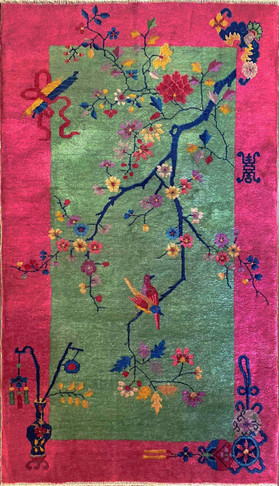
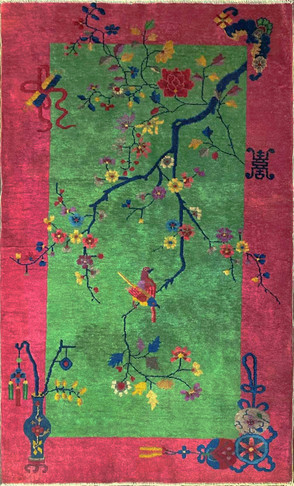
Introducing the first of our splendid pair, the Tree of Life Chinese rug, where artistry intertwines with symbolism. The enchanting jade green field hosts a majestic Tree of Life, where birds find sanctuary upon its branches, embracing the essence of freedom and harmony. Amidst the intricate design, several profound Chinese symbols grace the tapestry, weaving stories of prosperity and wisdom. A captivating Chinese signature embellishes the right side, sealing its authenticity and craftsmanship.
Introducing the first of our splendid pair, the Tree of Life Chinese rug, where artistry intertwines with symbolism. The enchanting jade green field hosts a majestic Tree of Life, where birds find sanctuary upon its branches, embracing the essence of freedom and harmony. Amidst the intricate design, several profound Chinese symbols grace the tapestry, weaving stories of prosperity and wisdom. A captivating Chinese signature embellishes the right side, sealing its authenticity and craftsmanship.
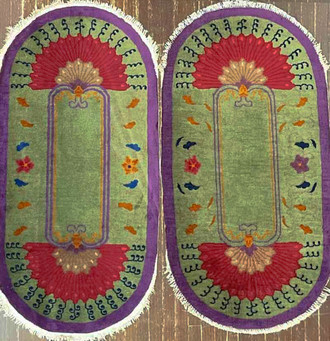
Pair of handmade Antique Art Deco Chinese Rugs, 2'6" x 4'10" Each, c-1920's
Amazing pair of handmade antique art deco rugs, in green and purple and red color background with floral traditional design. These rugs are in excellent condition and has been professionally cleaned.
This wonderful Art Deco carpet was made in China, circa 1910s or 1920s. It has purchased from a nice home in Chicago. Walter Nichols was great American rug producer (the Art Deco rugs which he did not originate them) in Tientsin.