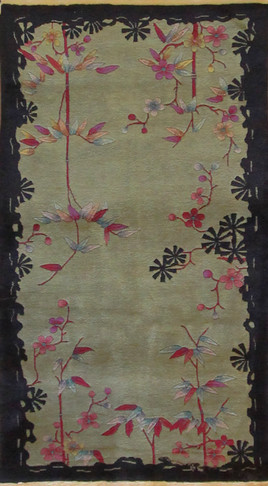
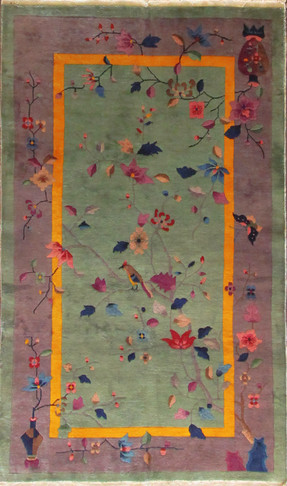
There are many beautiful art deco Chinese rugs in the market, but this one is very special, beautiful color and design giving a feeling of serenity and tranquility.
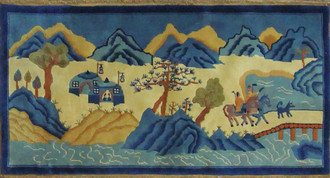
This wonderful Art Deco carpet was made in China, circa 1910s or 1920s. It has purchased from a nice home in Chicago. Walter Nichols was great American rug producer (the Art Deco rugs which he did not originate them) in Tientsin. The rugs made of wool and silk with bold vibrant colors and the pattern are pictorial scenes and trees, birds, clouds, mountains, dragons, butterfly and flowers.
Amazing color.
This wonderful Art Deco carpet was made in China, circa 1910s or 1920s. It has purchased from a nice home in Chicago. Walter Nichols was great American rug producer (the Art Deco rugs which he did not originate them) in Tientsin. The rugs made of wool and silk with bold vibrant colors and the pattern are pictorial scenes and trees, birds, clouds, mountains, dragons, butterfly and flowers. The production of Art Deco rugs started from 1910s-1950s and mostly with western influence.
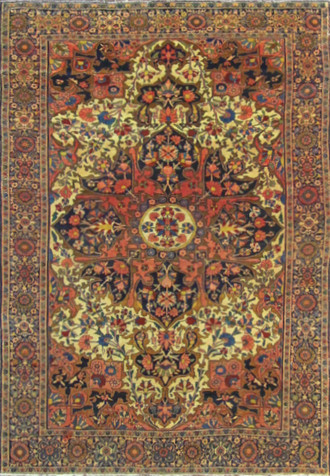
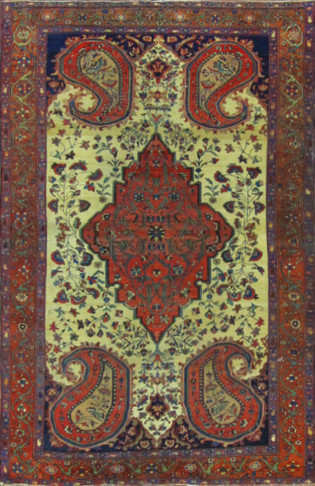
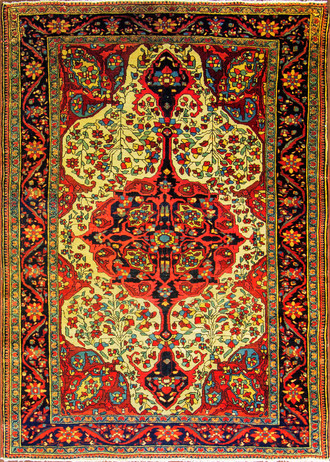
The Feraghan district area have a long history of rug and carpet weaving in the 19th century, many British companies opened oriental carpet factories and began to produce fine Persian Feraghan rugs and carpets for export to Europe. Antique Feraghan carpets and rugs are prized for their sturdy construction and their fine quality.
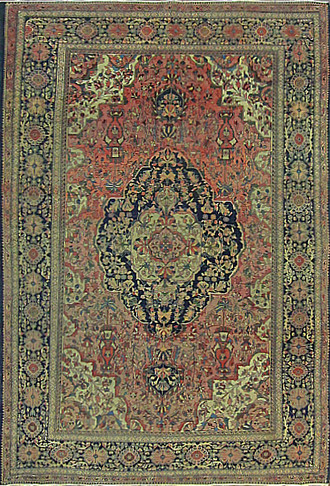
This elegant late-19th century Persian Sarouk Feraghan is a beautifully woven example from one of the most respected weaving regions of western Persia. Dating to approximately 1880, it combines the refined drawing of the Feraghan workshops with the durability and artistic character for which early Sarouk Feraghan rugs are highly prized.
The rug features a graceful ivory field surrounding a bold navy blue medallion with matching pendants, creating a striking yet balanced composition.
The Feraghan district area have a long history of rug and carpet weaving in the 19th century, many British companies opened oriental carpet factories and began to produce fine Persian Feraghan rugs and carpets for export to Europe. Antique Feraghan carpets and rugs are prized for their sturdy construction and their fine quality.
Feraghans were made between the 1870s and 1913 from a region north of the town of Arak. They are single wefted, long and narrow or room-sized carpets, typically with an all-over Herati design or floral and curling leaf motifs. Feraghan-Sarouks, also called Sarouks, are double-wefted, heavier carpets with a higher knot count than village Sultanabads. Fields are often blue or ivory and designs typically feature either large medallions or representations of trees and birds.