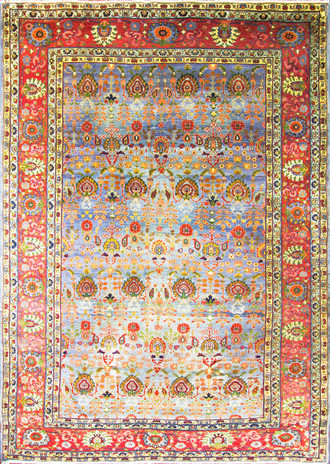
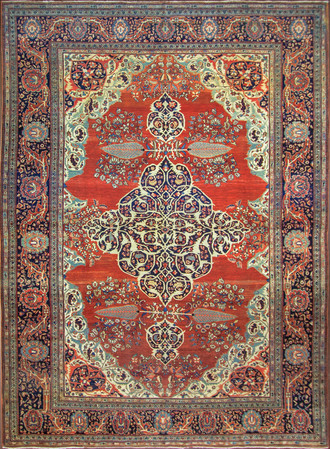
8'8" x 12'3" magnificent Tabriz Carpet, highly decorative with unusual grey blue background . Tabriz carpets are distinguished by their excellent weave and by their remarkable adherence to the classical traditions of Persian rug design. The city of Tabriz was the earliest capital of the Safavid dynasty. One of the most important figures in Tabriz rug making was the master weaver Haji Jalili and best known today for his incredible and unique approach to rug-making and his preference for distinctive color palettes and design elements.
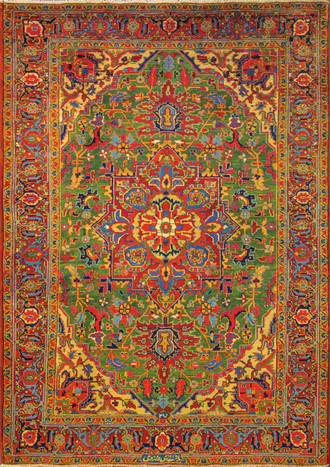
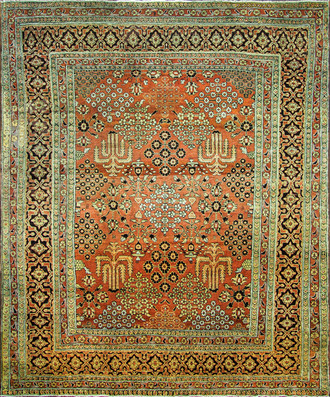
Very unusual green and tannish gold Persian Heriz carpet. The rug has been signed by the maker on the last border.
Heriz rugs are Persian rugs from the area of Heris, East Azerbaijan in northwest Iran, northeast of Tabriz. Such rugs are produced in the village of the same name in the slopes of Mount Sabalan. Heriz carpets are durable and hard-wearing and they can last for generations. 19th century examples of such carpets are often found on sale by major auction houses in United States and Europe.
These rugs are very heavy in relation to their size and sturdy and sometimes impossible to fold them because of their knotting technique. The material is wool knotted on wool foundation and the wool dyed with vegetable colors.
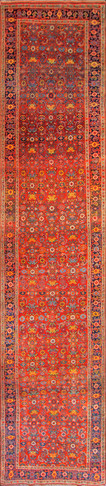
This rug made in northwestern Persia in the Kurdish village and the pattern is herati also called the mahi flower consists of a rosette enclosed in a diamond with curved leaves and small flowers. This runner has allover Herati Pattern and the Herati symbol is auspicious, and is often thought to bring good luck.
Mohajeran Gazan Carpet:
One of the top high end Persian carpet Maker.
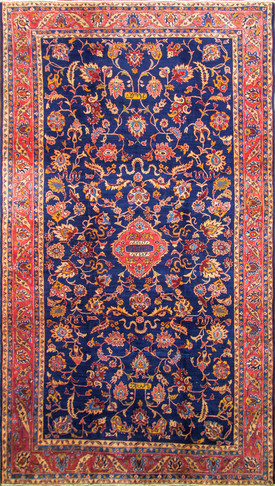
The source of this important provenance has been in the village of Sarouk. North of Arak (formerly Sultanabad). Sarouks are known to be of high quality. The pile is usually higher than the average Persian rug and therefore Sarouks are rather heavy and solid rugs, the wool being used is high quality durable wool. "Mohajeran" or "Mahajiran" is the name of a village West of Arak.
Feraghans were made between the 1870s and 1913 from a region north of the town of Arak, produced for the Persian aristocracy. They are single wefted, long and narrow or room-sized carpets, typically with an allover herati design or floral and curling leaf motifs. Feraghan-Sarouks, also called Sarouks, are double-wefted, heavier carpets with a higher knot count than village Sultanabads. Fields are often blue or ivory and designs typically feature either large medallions or representations of trees and birds
Sarouk (also Saruk or Sarough) rugs are those woven in the village of Saruk and also the city of Arak, Iran and the surrounding countryside. Sarouk rugs have been produced for much of the last century. The early successes of the Sarouk rug are largely owed to the American market. From the 1910s to 1950s, the “American Sarouk” also known as the “Painted Sarouk” was produced. American customers had an affinity for the Sarouk’s curvilinear and floral designs
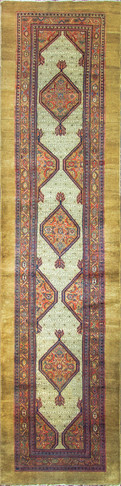
In the province of Azerbaijan in northwestern Iran, the village of Sarab served as the name source for antique Sarab rugs and it is located in northwest Iran in the province of Azerbaijan and they known for their fine long rugs or runners with a characteristic camel ground and lozenge-shaped medallions.
The city of Sultanabad (which is now known as Arak) was founded, in the early 1800s, as a center for commercial rug production in Iran. During the late 19th century, the firm of Hotz and Son and Ziegler and Co. established a manufacturer in Arak / Sultanabad whose sole objective was to produce rugs to meet the western demands.