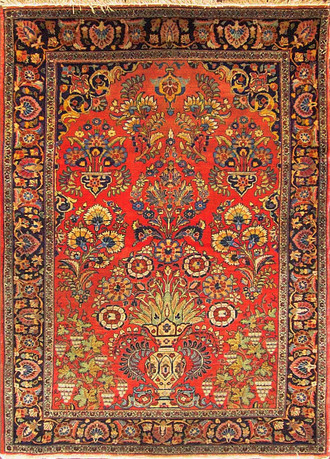
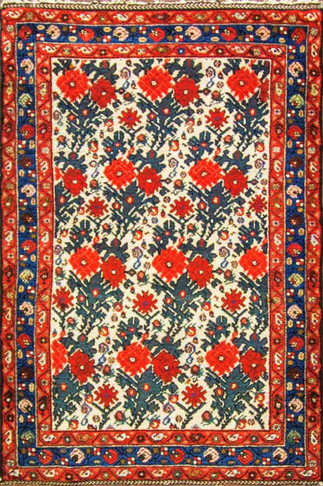
Made in Persia, circa 1920s, in perfect condition.
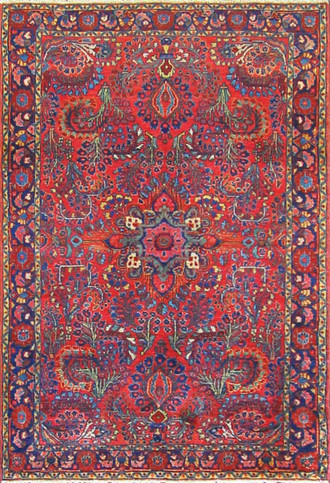
The source of this important provenance has been in the village of Sarouk. North of Arak (formerly Sultanabad). Sarouks are known to be of high quality. The pile is usually higher than the average Persian rug and therefore Sarouks are rather heavy and solid rugs, the wool being used is high quality durable wool. "Mohajeran" or "Mahajiran" is the name of a village west of Arak.
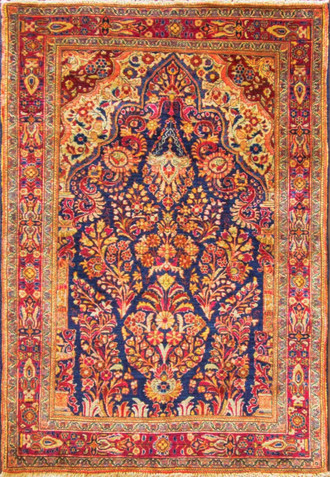
lustrous wool Persian Mohajeran Sarouk.
The source of this important provenance has been in the village of Sarouk. North of Arak (formerly Sultanabad). Sarouks are known to be of high quality. The pile is usually higher than the average Persian rug and therefore Sarouks are rather heavy and solid rugs, the wool being used is high quality durable wool. "Mohajeran" or "Mahajiran" is the name of a village West of Arak.
Sarouk, a small village and its neighboring villages in northwestern Iran are the source of large numbers rugs imported into the United States. The Sarouk carpet production came into existence around 1880 specifically for the European and North American markets. Before 1920s the Sarouk design was similar to that of the rug weaving centers of Ferahan and Tabriz. Most Sarouk rugs followed a very distinctive design and it depended on floral sprays and bouquets. Mohajeran refers to another village where rugs are produced
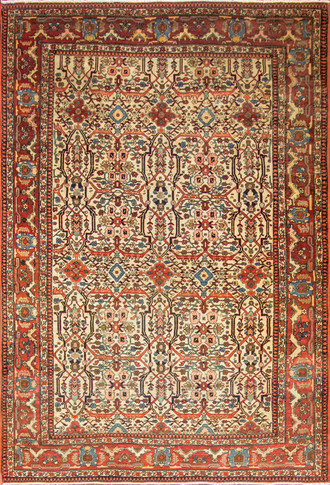
A beautiful and finely woven antique Persian Bakhtiari rug featuring a rare and highly decorative all-over floral design on a luminous ivory field. Unlike the more commonly encountered garden-panel (Kheshti) Bakhtiari rugs, this example displays an elegant arrangement of stylized blossoms, palmettes, and angular leafy vinery woven in a harmonious repeating pattern across the field.
The design is rendered in rich shades of madder red, deep indigo blue, soft sky blue, ivory, rose, and camel, creating a striking contrast that gives the rug exceptional visual appeal.
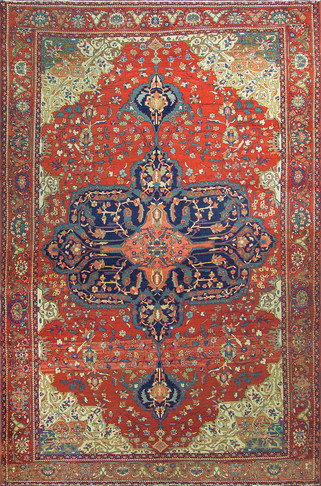
Most desirable Feraghan Sarouk with the all over design and ivory background. Feraghans were made between the 1870s-1913 from a region north of the town of Arak, produced for the Persian aristocracy. They are single wefted, long and narrow or room-sized carpets, typically with an all-over herati design or floral and curling leaf motifs. Feraghan-Sarouks, also called Sarouks, are double-wefted, heavier carpets with a higher knot count than village Sultanabad. Fields are often blue or ivory and designs typically feature either large medallions or representations of trees and birds
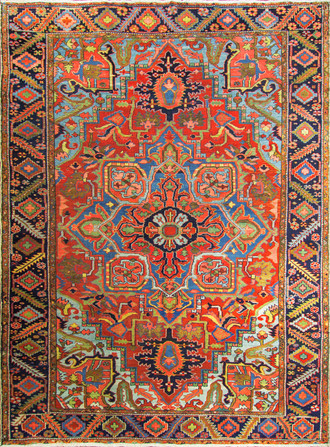
This Heriz carpet has distinct color combination and bold geometric designs. Heriz rugs are Persian rugs from the area of Heris, East Azerbaijan in northwest Iran, northeast of Tabriz. Such rugs are produced in the village of the same name in the slopes of Mount Sabalan. Heriz carpets are durable and hard-wearing and they can last for generations. 19th century examples of such carpets are often found on sale by major auction houses in United States and Europe.
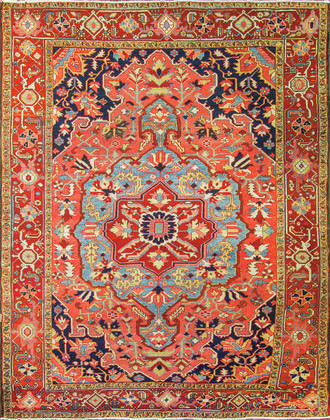
Light salmon with blue background color and rose border. Woven in the rugged mountains of Northwest Persia, Serapi rugs are a distinct Heriz region style, with finer knotting and more large-scale spaciously placed antique carpet designs than other rugs from this area. Persian carpets had to be taken by their weavers to Serab, 30 miles distant, to be marketed. “Serapi” is not a place or tribal name, rather it is a market term derived from “Serab-i,” meaning “of Serab.” The bold geometric designs are probably connected to the tribal Caucasian traditions across the Aras River to the north.