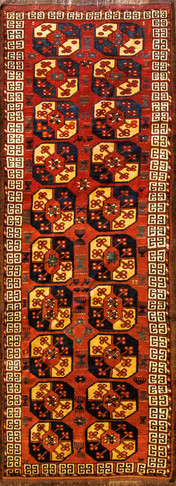
This runner has a rich color's field that displays two columns of characteristic octagonal Ersari tribal guls quartered in gold green and blue. There is a abrashes lighter in the red. A very attractive Central Asian Turkmen carpet in quite good condition with only minimal wear.
The guls throughout of the runner are in different dimension, that is a good sign of the old age and made in the village and it didn't made for export.
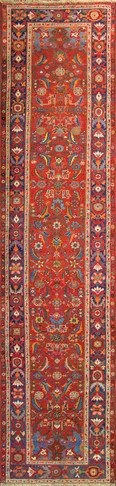
This exceptional Antique Persian Bakhtiari runner, woven around 1910, is a magnificent example of the bold artistry and enduring craftsmanship for which Bakhtiari weavings are renowned.
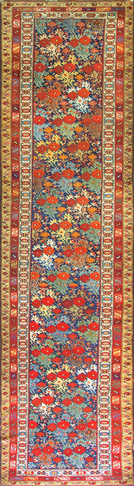
A dynamic and exciting composition, this gorgeous late 19th century Bidjar runner from the 1880s showcases some of the finer qualities exhibited by the Persian iron rug of Iran. This antique Bijar is a historical rug woven in the village of Halwai, North-East of Bijar. This Halwai Persian Bidjar is immersed in Persian culture and reflects first-class prestige, a true collector’s piece. This beautifully detailed Persian Bijar boasts an ornate elaborate all-over pattern, rendered in exquisite detail. The intricate finials seem to float majestically within its abashed red open field.
Heriz rugs are from the area of Heris, East Azerbaijan in Northwest Iran, Northeast of Tabriz. Heriz carpets are durable and hard-wearing and they can last for generations. 19th century examples of such carpets are often found 1n houses in United States and Europe. Part of the reason for the toughness of Heriz carpets is that Mount Sabalan sits on a major deposit of copper. Traces of copper in the drinking water of sheep produces high quality wool that is far more resilient than wool from other areas.
Beautiful colors with fine quality, circa 1920.
Produced south of the city of Arak by Armenians in Persia, Lilihan rugs are known for their design. Traditionally designed with a curvilinear lattice with traditional floral motifs these rugs also feature geometric designs. The primary characteristic of Lilihan rugs is the abundant use of pink although khaki and brown ornament the salamander background. Made with a long pile, these rugs are often mid-sized and favored by American tastes. The visually stunning Lilihan rug is a favourite due to its durability, longer pile, and vibrant colors.
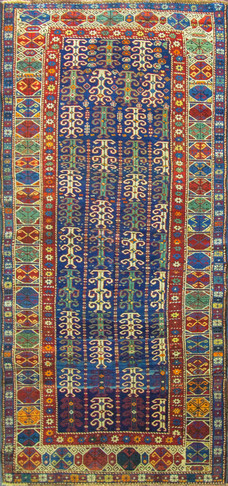
Highly unusual design antique colorful long Kazak rug.
The Caucasus is bounded by the rugged mountains and lush valleys of Armenia, Azerbaijan and Georgia. This cultural melting pot was populated by Armenian dyers and weavers, Azeri Turks, groups from the Northern Caucasus and minorities from the surrounding areas. The Kazak rugs of the Caucasus are distinctive and individual. Geometric people and animals, symbolic motifs, dramatic medallions, crenellated fence borders, angular cloud-bands and graphic latch.
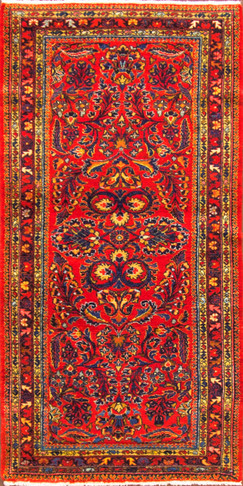
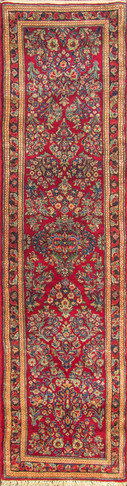
A handsome and finely woven antique Persian Sarouk runner dating to approximately 1930, preserved in excellent condition with a remarkably full, luxurious pile.
The runner features a rich deep red field filled with an elaborate succession of floral sprays, flowering branches, palmettes, rosettes, and scrolling vines.
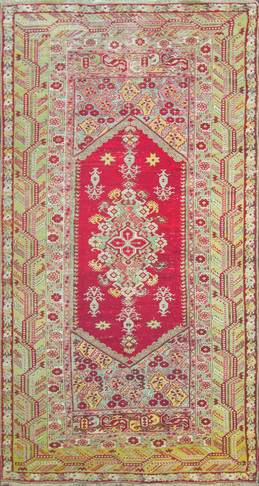
The Ghiordes captured the hearts of European collectors in the 1700s. Ture s, highly decorative spandrel and gorgeous monochromatic fields. These stunning rugs are typically made from the highest quality wool. This construction technique produces beautiful and extremely durable rugs.
The grand room-sized carpets of Ghiordes include a marvellous variety of angular medallions, graceful curvilinear arabesques and repeating motifs. In general, antique Turkish carpets from the area tend to favour botanical motifs and florals rather than the angular symbols that are depicted in some Turkish rugs.