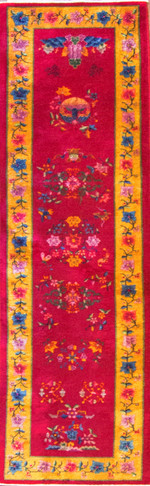
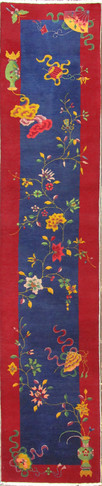
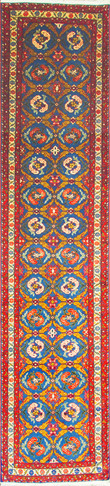
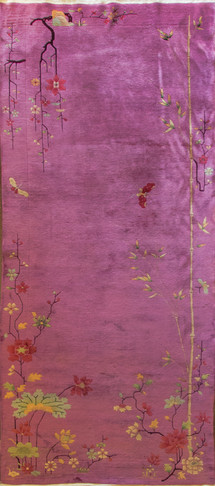
This wonderful Art Deco runner was made in China, circa 1910s or 1920s, measures: 2'5" x 8'6". Walter Nichols was great American rug producer (the Art Deco rugs which he did not originate them) in Tientsin. The rugs made of wool and silk with bold vibrant colors and the pattern are pictorial scenes and trees, birds, clouds, mountains, dragons, butterfly and flowers. The production of Art Deco rugs started from 1910s-1950s and mostly with western influence.
This wonderful Art Deco carpet was made in China, circa 1910s or 1920s. It has purchased from a nice home in Chicago. Walter Nichols was great American rug producer (the Art Deco rugs which he did not originate them) in Tientsin. The rugs made of wool and silk with bold vibrant colors and the pattern are pictorial scenes and trees, birds, clouds, mountains, dragons, butterfly and flowers. The production of Art Deco rugs started from 1910s-1950s and mostly with western influence.
This Runner is in excellent condition with high pile throughout the rug, cleaned and no stained, the ends and bindings of the rug are intact as original and there has not been any repairs. There are no tears, breaks or holes.
The materials are from vegetable dyes wool pile over cotton foundation. The pattern is floral with fish design.
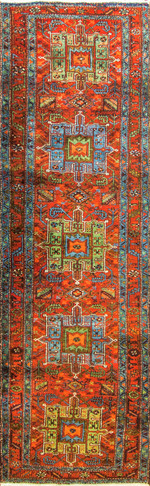
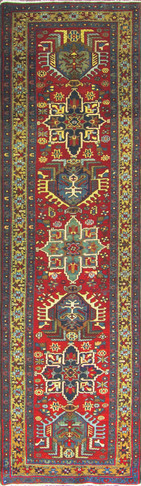
This wonderful runner was made in Caucuses, circa 1930s or 1940's. It has purchased from a nice home in New York.
2'5" x 14'10" Persian Kerman Runner, c-1950 in excellent condition.
Kirman was a very important antique rug weaving centre dating from the Golden Age of Persian culture under the Safavid dynasty in the 16th century, on a par with Tabriz and Kashan in esteem. The color palette of Laver Kirman antique Persian rugs is unusually soft and delicate with a European grace.
This wonderful Art Deco carpet was made in China, circa 1910s or 1920s. Walter Nichols was great American rug producer (the Art Deco rugs which he did not originate them) in Tientsin. The rugs made of wool and silk with bold vibrant colors and the pattern are pictorial scenes and trees, birds, clouds, mountains, dragons, butterfly and flowers. The production of Art Deco rugs started from 1910s-1950s and mostly with western influence. Measures: 4'10" x 11'5".
Great size with gorgeous colors and good quality and condition.
Antique Persian Heriz rug, Persia, circa 1920. This remarkable and artistic antique rug, showcases an ornate, multicolored central design. At the heart of the antique Persian Heriz Serapi rug, a many-petaled flower is surrounded by a 12-pointed stellar shape in light and dark blue. Angular stylized flowers stud the navy form and are echoed across the red medallion that encases it. Four ornaments decorate the corners of the medallion, and floral adornments nestle within each tip.
Beautiful combination of the tan color border and the red multi field colors with a spectacular design.
Heriz rugs are Persian rugs from the area of Heriz, East Azerbaijan in Northwest Iran, Northeast of Tabriz. Such rugs are produced in the village of the same name in the slopes of Mount Sabalan. Heriz carpets are durable and hard-wearing and they can last for generations. 19th century examples of such carpets are often found on sale by major auction houses in United States. This particular runner has a super quality and condition.
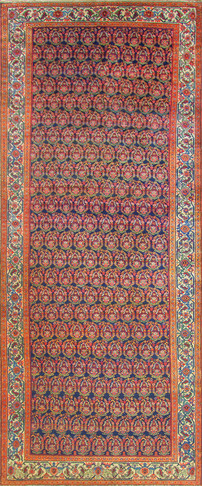
Remarkable fine antique Persian Senneh Malayer galley size carpet, circa 1900 in excellent condition.
The tribal weavers in Malayer were often Turkish, and they employed the Turkish knot. The Gourde is a symmetrical knot, as opposed to the asymmetrical knot of many traditionally Persian creations. Additionally, antique Malayer rugs regularly enjoy a low cut pile. Weavers trimmed the pile in order to enhance the appearance of the design. In addition to a broad range of design and color, these rugs were designed technically to enhance the artistry of the woven design.