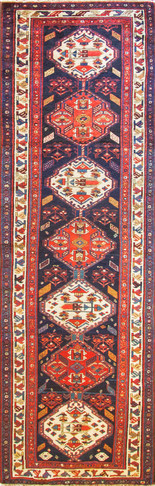
This handsome Antique Persian Bakhtiari Runner, woven around 1900, is an excellent example of the robust craftsmanship and bold tribal artistry for which the Bakhtiari weavers of western Persia are renowned. Its balanced geometric composition and rich natural colors make it a versatile and highly decorative runner, ideal for a hallway, gallery, or traditional interior.
The deep midnight-blue field is anchored by a striking procession of alternating ivory and rust-red octagonal medallions, each enclosing stylized geometric motifs and symbolic tribal emblems.
The dramatic navy blue field is organized around a series of large rust-red geometric medallions alternating with ivory hexagonal compartments, each filled with an array of stylized tribal motifs, symbolic devices, and traditional protective emblems.
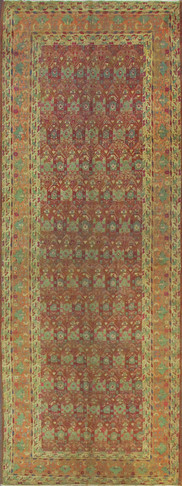
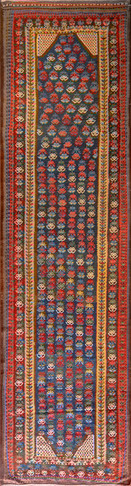
This exceptional Antique Caucasian Karabagh Runner, woven around 1890, is a magnificent example of the artistic tradition of the Karabagh weaving region. Its extraordinary length and elegant allover composition make it an ideal statement piece for a grand hallway, gallery, or expansive interior requiring a truly distinctive antique textile.
The deep midnight blue field is richly adorned with an allover arrangement of stylized floral sprays, palmettes, and delicate vine work rendered in vibrant shades of crimson, raspberry, ivory, soft sky blue, sage green, and golden yellow.
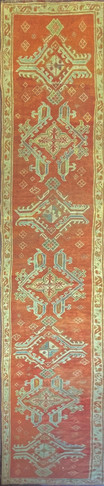
This striking Antique Turkish Oushak runner, woven around 1890, is an elegant example of late nineteenth-century Anatolian craftsmanship. Its exceptional length and beautifully balanced geometric composition make it an ideal hallway runner while also serving as a highly decorative collector's piece.
The warm soft terracotta field is arranged with a procession of bold, stylized geometric medallions, each displaying distinctive hooked motifs and intricate latch-hook forms characteristic of the finest Oushak village weavings.
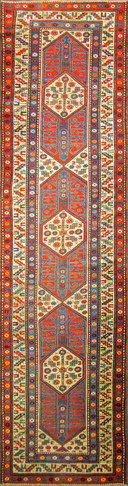
This exceptional Antique Caucasian Kazak Kurdish Runner, woven around 1900, is a striking example of the bold geometric artistry and outstanding craftsmanship for which the finest Caucasian village weavings are celebrated. Its elongated proportions make it an ideal hallway runner while preserving the powerful tribal character that distinguishes authentic antique Kazak rugs.
The ivory field is anchored by a dramatic procession of three large, elongated hexagonal medallions in rich terracotta and sky blue.
A gorgeous Agra gallery rug.
Agra is a large city and weaving district in North Central India that has been prolific in producing tightly knotted, decorative, floral rugs. Antique Agra rugs are renowned for their beauty of color, elegance of drawing and perhaps above all fineness of knotting. Agra colors are mostly red yellow green and ivory. The design is famous for its floral tendrils, angular vines and stars. Probably the most sophisticated carpet look with softness of visual impact to harmonize the atmosphere.
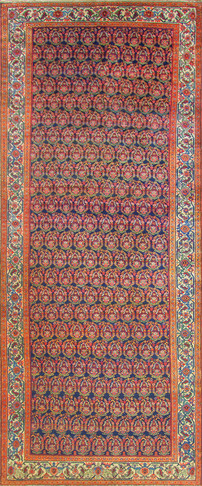
Remarkable fine antique Persian Senneh Malayer galley size carpet, circa 1900 in excellent condition.
The tribal weavers in Malayer were often Turkish, and they employed the Turkish knot. The Gourde is a symmetrical knot, as opposed to the asymmetrical knot of many traditionally Persian creations. Additionally, antique Malayer rugs regularly enjoy a low cut pile. Weavers trimmed the pile in order to enhance the appearance of the design. In addition to a broad range of design and color, these rugs were designed technically to enhance the artistry of the woven design.
Soumak is a tapestry technique of weaving strong and decorative textiles used as rugs and domestic bags. Baks used for bedding are known as Soumak Mafrash. Soumak is a type of flat-weave, somewhat resembling but stronger and thicker than Kilim, with a smooth front face and a ragged back; where Kilim is smooth both sides. Soumak lacks the slits characteristic of Kilim, as it is usually woven with supplementary weft threads as continuous supports.
The technique involves wrapping colored weft threads over and under the warp threads, adding strength and embroidery-like pattern.