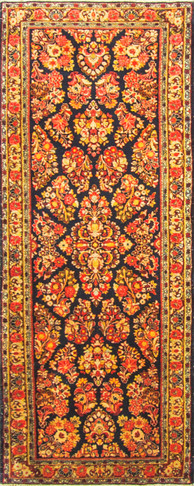
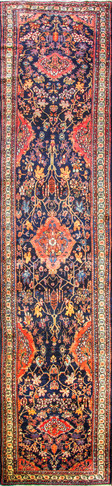
This elegant antique Persian Sarouk Mohajeran runner is a superb example of the finest weaving tradition from the Mohajeran village, located west of Sarouk in central Persia. Woven around 1920, it represents the premium grade of Sarouk production, renowned for its exceptionally lustrous wool, fine knot density, and sophisticated floral artistry.
Absolutely gorgeous antique Persian Kurdish Bijar Halvayi runner gallery carpet with wool foundation and beautiful Harrati pattern and Abrash with vegetable dyes in red gold and light blue in excellent condition, circa 1900s.
Bidjar is the name of a small Kurdish town in western Iran. (or Bidjar) Kurdish rugs are often called the Iron Rugs of Iran. The Bijar was a heavy, durable rug that has been very popular in the United States. Now the Bijar rug tends to be a finer, thinner and more Sarouk-like rug.
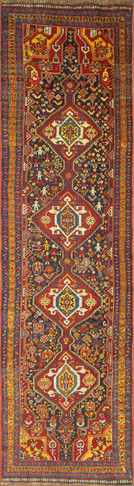
The Qashgai nomads are found in the Fars province in the southwest of Iran. They move twice a year, between the winter pasture near the Persian Gulf and the summer pasture up in the Zagros mountains where it is much cooler. The carpets have a typical red-brown ground color. The pattern is tied from memory and often consists of a centrally placed medallion, repeated in all four corners. Humans, four legged animals, birds, trees and flowers are popular elements. Qashgai carpets consist of a hexagon or diamond with four projecting hooks inside of a hooked diamond.
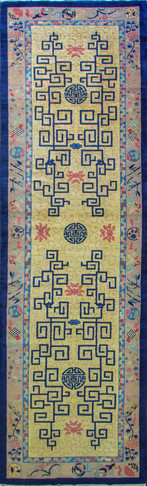
5'2" x 17'10" Unusual Art Deco Gallery Size Carpet, c-1920 in excellent condition.
This wonderful Art Deco carpet was made in China, circa 1910s or 1920s. It has purchased from a nice home from Washington. Walter Nichols was great American rug producer (the Art Deco rugs which he did not originate them) in Tientsin. The rugs made of wool and silk with bold vibrant colors and the pattern are pictorial scenes and trees, birds, clouds, mountains, dragons, butterfly and flowers. The production of Art Deco rugs started from 1910s-1950s and mostly with western influence
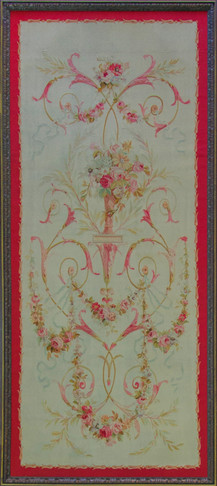
Sleek and sophisticated, this flat-weave panel or runner features a tapestry floral design. This colorful runner brings instant comfort and style to any space.
Measure: 4'9" x 9'8" and measure in the frame 4'2" x 9'7".
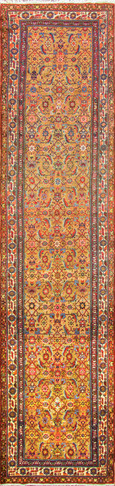
This elegant Antique Persian Malayer runner, woven around 1920, is a superb example of the refined village craftsmanship for which the Malayer weaving district is celebrated. Its impressive length, graceful proportions, and finely detailed all-over design make it an ideal choice for a grand hallway or gallery space.
The runner features a warm golden camel field filled with an intricate lattice of delicate floral sprays, palmettes, rosettes, and gracefully curving boteh (paisley) motifs.
The Bakhtiari tribe, based in Chahar Mahaal and Bakhtiari, is well-known for their rugs and weavings. They have been weaving rugs exported around the globe since the early 19th century.
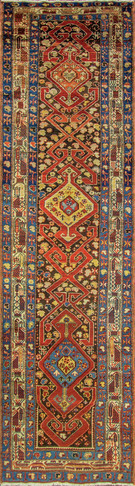
This handsome Antique Northwest Persian runner, woven around 1900, is a striking example of the bold geometric artistry and durable village craftsmanship that distinguish the finest tribal weavings of the region. Its impressive length and dynamic composition make it an exceptional choice for a hallway, gallery, or other elongated interior space.
The rich walnut-brown field is anchored by a dramatic sequence of large angular medallions in brick red, sky blue, ivory, and soft gold, linked together by stylized hooked motifs that create a powerful sense of movement throughout the runner.