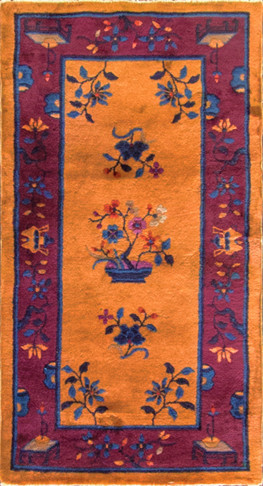
This wonderful Art Deco carpet was made in China, circa 1910s or 1920's. Walter Nichols was great American rug producer (the Art Deco rugs which he did not originate them) in Tientsin. The rugs made of wool and silk with bold vibrant colors and the pattern are pictorial scenes and trees, birds, clouds, mountains, dragons, butterfly and flowers. The production of Art Deco rugs started from 1910s-1950s and mostly with western influence.
The materials are from vegetable dyes wool pile over cotton foundation. The pattern is floral in deco style.
This wonderful Art Deco carpet was made in China, circa 1910s or 1920's. Walter Nichols was great American rug producer (the Art Deco rugs which he did not originate them) in Tientsin. The rugs made of wool and silk with bold vibrant colors and the pattern are pictorial scenes and trees, birds, clouds, mountains, dragons, butterfly and flowers.
Foundation: Wool pile on cotton foundation
Colors: Deep indigo-blue field, rich brick red, ivory, soft green, camel, and touches of golden yellow
This beautiful antique Persian Sultanabad rug is a classic example of the highly decorative village weavings produced in the Arak region during the late 19th century.
A very attractive antique Navajo handwoven rug featuring a wonderfully simple and graphic banded geometric composition.
The design is organized into four broad ivory horizontal panels, each decorated with a repeating row of bold serrated diamond motifs. The diamonds are rendered primarily in soft brick and coral red surrounding warm tan centers.
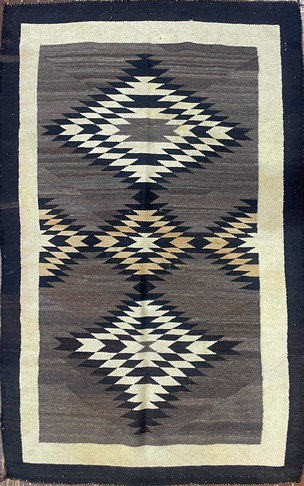
An exceptional early Navajo weaving distinguished by its dramatic geometric composition and sophisticated use of natural, undyed wool in black, ivory, charcoal, gray and subtle brown-gray tones.
The design features three powerful geometric formations arranged vertically through the field. Large serrated diamond and stepped motifs are rendered in sharply contrasting black and ivory, creating a striking sense of movement against the beautifully variegated gray ground.
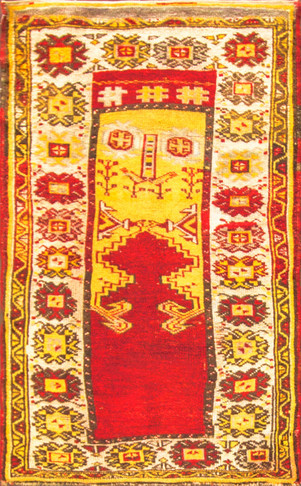
The city of Uşak, Turkey, one of the larger towns in Western Anatolia, which was a major center of rug production from the early days of the Ottoman Empire, into the early 20th century.
Popular colors and antique or modern design.
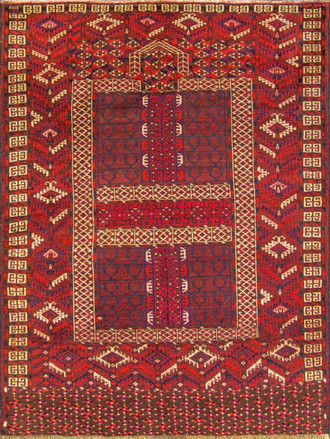
almost all Turkmen rugs were produced by nomadic tribes almost entirely with locally obtained materials, wool from the herds and vegetable dyes, or other natural dyes from the land. They used geometrical designs that varied from tribe to tribe; most famous are the Yomut, Ersari, Saryk, Salor, and Tekke. Irregularities — considered part of the charm by many rug collectors — were fairly common since natural materials varied from batch to batch and woolen warp or weft may stretch, especially on a loom that is regularly folded up for transport and set up a new at another camp.
An exceptionally attractive matched pair of antique Tekke Turkmen chuval faces, dating to the late nineteenth century and surviving together in remarkably fine condition.
Each piece displays the classic six-gul composition, arranged in two horizontal rows of three large turreted guls across a rich crimson-to-deep madder-red field.