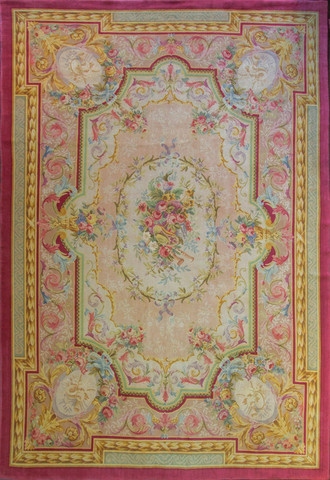
Aubusson rugs are very accurate reproductions of absolutely original French designs produced from the 17th through 19th century in the factories of Aubusson, which gave the name to these rugs. Originally they were produced for the French royal family, but later on, important artists and architects cooperated with this factory and the production could be increased to satisfy the demand of the noble and new bourgeois families. In the past few years Aubusson rugs are again very much appreciated, and they are successfully used in classic and contemporary home.
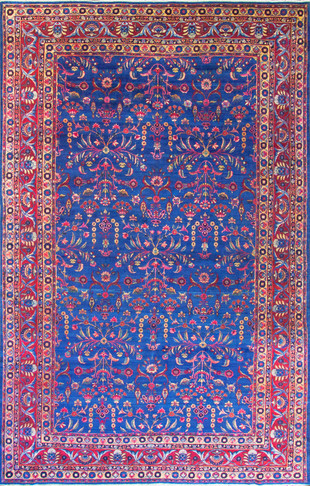
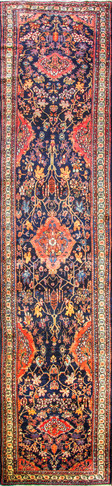
Antique Persian Laver Kerman carpet, amazing color in excellent condition with unique blue background.
Kirman was a very important antique rug weaving centre dating from the Golden Age of Persian culture under the Safavid dynasty in the 16th century, on a par with Tabriz and Kashan in esteem. The color palette of Laver Kirman antique Persian rugs is unusually soft and delicate with a European grace.
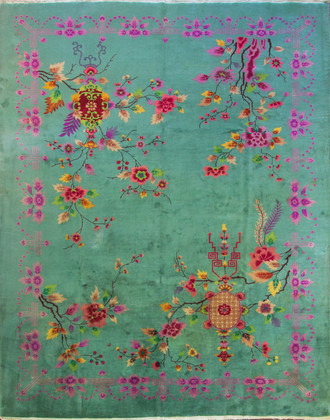
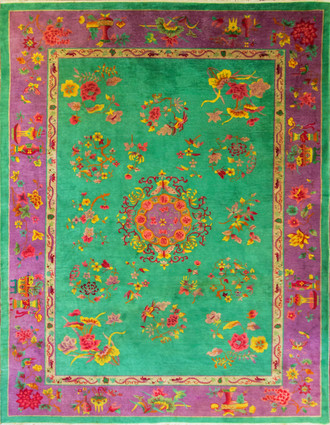
Soft jade green background with beautiful floral design.
The Art Deco period was an international design movement from 1920s-1940s.
Art Deco rugs are characterized by experimentation with bold colors, angular lines, and the omission of heavy ornamentation.
Walter Nichols was great American rug producers (the Art Deco rugs which he did not originate them) in Tientsin. The rugs made of wool and silk with bold vibrant colors and the pattern are pictorial scenes and trees, birds, clouds, mountains, dragons, butterfly and flowers.
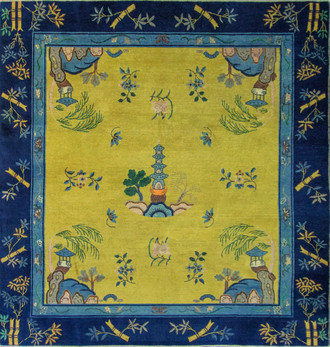
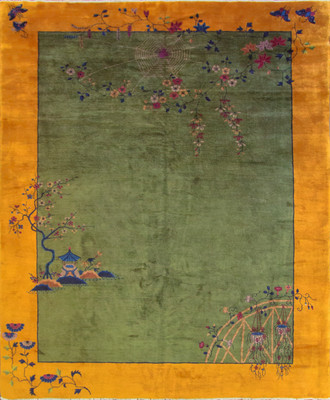
8' x 8'8" antique unusual Art Deco Chinese carpet, circa 1920 in excellent condition.
Soft gold and blue background color with Chinese symbols of Pagoda and other Chinese motives.
Dragon Art Deco carpet, amazing colors, circa 1920 Chinese rug in excellent condition with a very minor area of low pile.
The Art Deco period was an international design movement from 1920s-1940s.
Art Deco rugs are characterized by experimentation with bold colors, angular lines, and the omission of heavy ornamentation.
Walter Nichols was great American rug producers (the Art Deco rugs which he did not originate them) in Tientsin. The rugs made of wool and silk with bold vibrant colors and the pattern are pictorial scenes and trees, birds, clouds, mountains, dragons, butterfly and flowers.
This wonderful Art Deco carpet was made in China, circa 1910s or 1920s. Walter Nichols was great American rug producer (the Art Deco rugs which he did not originate them) in Tientsin. The rugs made of wool and silk with bold vibrant colors and the pattern are pictorial scenes and trees, birds, clouds, mountains, dragons, butterfly and flowers. The production of Art Deco rugs started from 1910s-1950s and mostly with western influence.
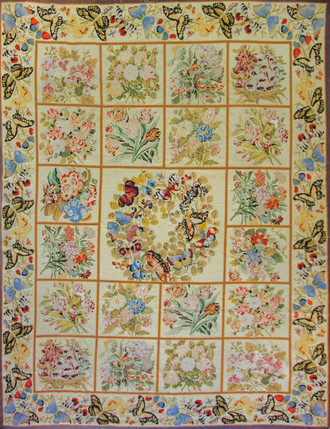
This antique English rug is a rare treat for the connoisseurs of traditional art and craft.
Using a sewing needle and wool yarn to create stitches on an open grid cotton fabric called a “canvas”. This method of execution resulted in millions of individual stitches which gave a pile-less yet palpable texture and a characteristic, slightly rustic character.
This square English needlework rug consists of twenty one polygons with pastoral scenes, wreaths and flower bouquets, separated by a simple lattice with diamonds.
The Bakhtiari tribe, based in Chahar Mahaal and Bakhtiari, is well-known for their rugs and weavings. They have been weaving rugs exported around the globe since the early 19th century.