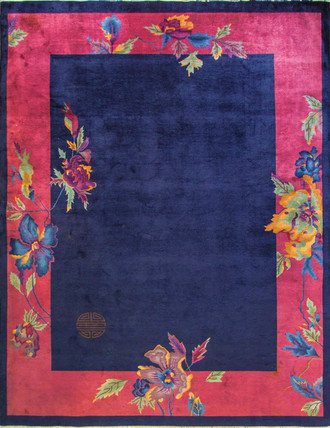
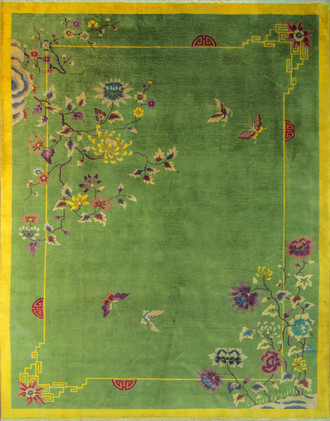
This wonderful Art Deco carpet was made in China, circa 1910s or 1920's. Walter Nichols was great American rug producer (the Art Deco rugs which he did not originate them) in Tientsin. The rugs made of wool and silk with bold vibrant colors and the pattern are pictorial scenes and trees, birds, clouds, mountains, dragons, butterfly and flowers. The production of Art Deco rugs started from 1910s-1950s and mostly with western influence.
One of the top high end Persian carpet maker.
The source of this important provenance has been in the village of Sarouk. North of Arak (formerly Sultanabad). Sarouks are known to be of high quality. The pile is usually higher than the average Persian rug and therefore Sarouks are rather heavy and solid rugs, the wool being used is high quality durable wool. "Mohajeran" or "Mahajiran" is the name of a village West of Arak.
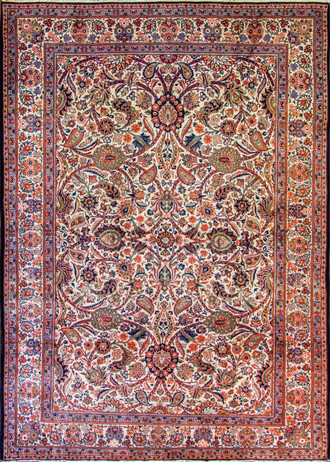
Great condition and quality Persian Kashan carpet, circa 1930.
Amazing size and beautiful blue background with all-over floral design in multi colors.
A Kashan rug made in Persia in the city of Kashan in Isfahan Province North Central Iran. There was production of Persian carpet at Royal workshops in the 17th and early 18th century. The Persian carpet workshops ceased production in about 1722 after the Afghan invasion. Persian carpet production was very minor until the 20th century. Historically, Kashan was a major centre in the garment trade.
This wonderful Art Deco carpet was made in China, circa 1910s or 1920's. Walter Nichols was great American rug producer (the Art Deco rugs which he did not originate them) in Tientsin. The rugs made of wool and silk with bold vibrant colors and the pattern are pictorial scenes and trees, birds, clouds, mountains, dragons, butterfly and flowers. The production of Art Deco rugs started from 1910s-1950s and mostly with western influence.
Made in Persia, circa 1920s, in perfect condition.
The source of this important provenance has been in the village of Sarouk. North of Arak (formerly Sultanabad). Sarouks are known to be of high quality. The pile is usually higher than the average Persian rug and therefore Sarouks are rather heavy and solid rugs, the wool being used is high quality durable wool. "Mohajeran" or "Mahajiran" is the name of a village west of Arak.
From Sultanabad region of Persia, circa 1920.
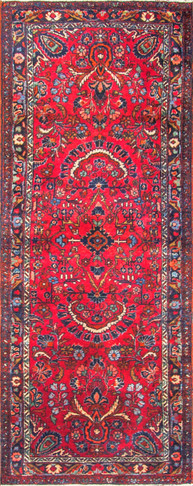
Lilihan is one of a group of Armenian villages which makes the rugs known as Lilihan. Measures: 2'9" x 7'1".
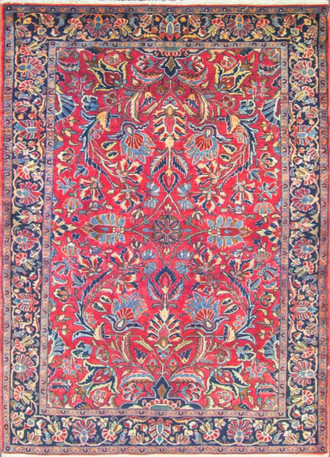
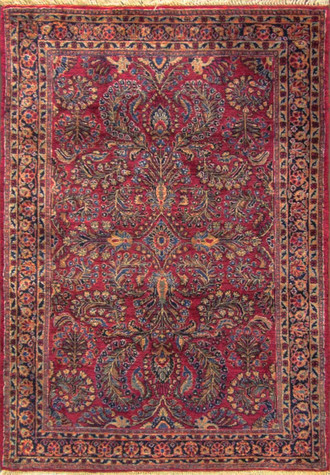
This exceptional antique Mohajeran Sarouk rug, measuring approximately 3'3" x 5' and dating to around 1920, is a superb example of the highly sought-after Mohajeran workshop weaving tradition rug. Mohajeran Sarouks are widely considered among the finest and most elegant Sarouk carpets ever produced, celebrated for their luxurious wool quality, refined drawing, and extraordinary decorative richness.
The rug displays a beautifully balanced allover floral composition set upon a luminous ruby-crimson field of remarkable depth and saturation.
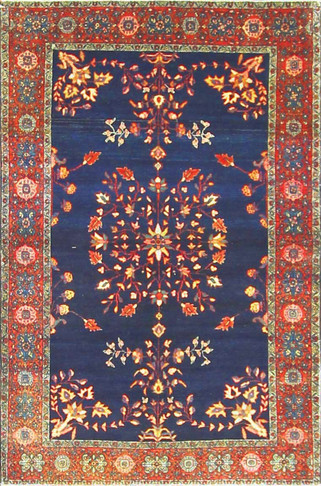
A beautiful and exceptionally fine antique Persian Feraghan Sarouk rug dating to circa 1890, distinguished by its unusual deep midnight-blue field, elegant floral drawing, and remarkable state of preservation.
The open navy-blue field provides a dramatic background for a finely articulated floral composition arranged around a delicate central flowering medallion. Graceful flowering branches, palmettes, leaves, and small blossoms extend vertically through the field while leaving generous open space around the design.