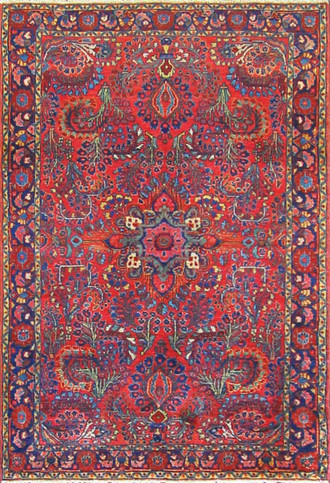
Made in Persia, circa 1920s, in perfect condition.
The source of this important provenance has been in the village of Sarouk. North of Arak (formerly Sultanabad). Sarouks are known to be of high quality. The pile is usually higher than the average Persian rug and therefore Sarouks are rather heavy and solid rugs, the wool being used is high quality durable wool. "Mohajeran" or "Mahajiran" is the name of a village west of Arak.
lustrous wool Persian Mohajeran Sarouk.
The source of this important provenance has been in the village of Sarouk. North of Arak (formerly Sultanabad). Sarouks are known to be of high quality. The pile is usually higher than the average Persian rug and therefore Sarouks are rather heavy and solid rugs, the wool being used is high quality durable wool. "Mohajeran" or "Mahajiran" is the name of a village West of Arak.
Sarouk, a small village and its neighboring villages in northwestern Iran are the source of large numbers rugs imported into the United States. The Sarouk carpet production came into existence around 1880 specifically for the European and North American markets. Before 1920s the Sarouk design was similar to that of the rug weaving centers of Ferahan and Tabriz. Most Sarouk rugs followed a very distinctive design and it depended on floral sprays and bouquets. Mohajeran refers to another village where rugs are produced
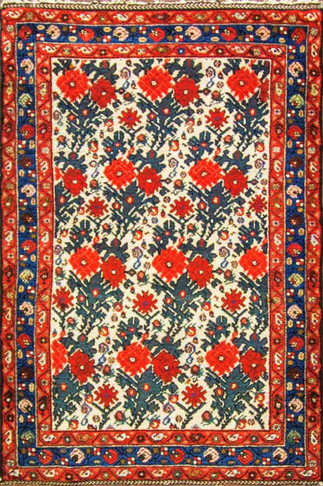
A beautiful and finely woven antique Persian Bakhtiari rug featuring a rare and highly decorative all-over floral design on a luminous ivory field. Unlike the more commonly encountered garden-panel (Kheshti) Bakhtiari rugs, this example displays an elegant arrangement of stylized blossoms, palmettes, and angular leafy vinery woven in a harmonious repeating pattern across the field.
The design is rendered in rich shades of madder red, deep indigo blue, soft sky blue, ivory, rose, and camel, creating a striking contrast that gives the rug exceptional visual appeal.
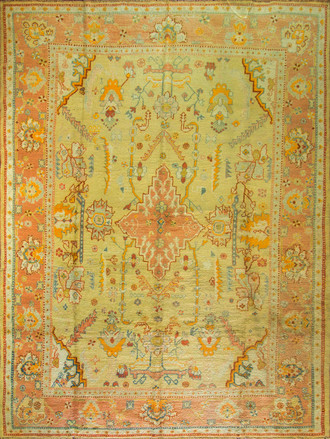
Ushak rugs have been in production since the 15th century with superb wool and natural dyes. Unlike other Turkish rugs, Ushak rugs influenced after Persian rugs and the woven with Ghiordies knots and all double knotted, their design is feature intricate motifs of vines and leaves and typically based on geometric motifs.
Oushak carpets are long-time favorites among admirers of antique Ottoman rugs. Originating in Turkish carpet weaving workshops, Oushak rugs were frequently represented in paintings by European masters, such as Vermeer and Velasquez, as well as used to adorn royal interiors.
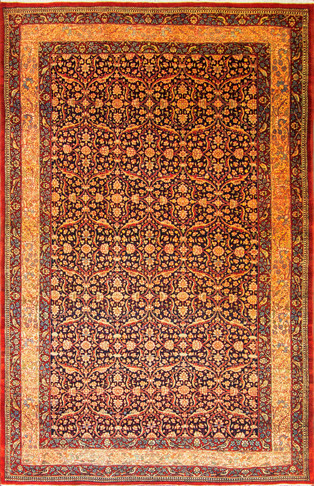
Antique Tehran Carpet, Country of Origin: Persia, Circa Date:1900 — Minuscule details are gorgeously presented throughout the Tehran carpet to create a vivacious tapestry of floral elements and dancing petals. Several borders frame around each other throughout the work, sewn in earthy browns, cool beiges, rich taupes and delicate creams. Within each of these borders are closely knit petals and blossoms, with the largest frame bearing an encircling row of sky blue vases that house pomegranate red flowers.
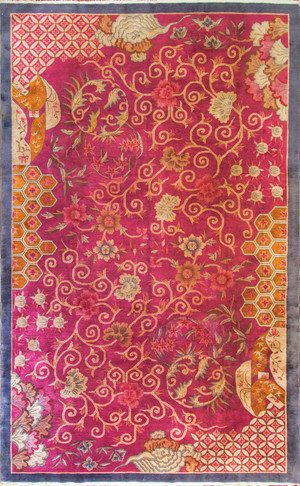
This wonderful unusual Art Deco carpet was made in China, circa 1910s or before. It has purchased from a nice home in Miami Florida and it is in good condition with some area of wear. It has very fine quality wool and attractive all-over one kind of design. Walter Nichols was great American rug producer (the Art Deco rugs which he did not originate them) in Tientsin. The rugs made of wool and silk with bold vibrant colors and the pattern are pictorial scenes and trees, birds, clouds, mountains, dragons, butterfly and flowers.