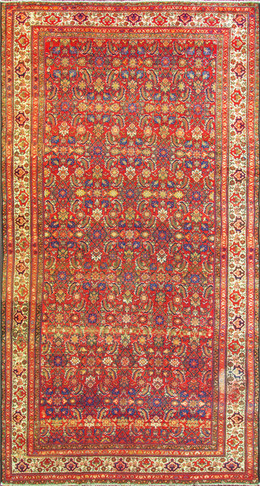
A very busy Herati center and a pleasant border design with running water and trees. The tribal weavers in Malayer were often Turkish, and they employed the Turkish knot, Gourde, to weave these creations. The Gourde is a symmetrical knot, as opposed to the asymmetrical knot of many traditionally Persian creations. Additionally, antique Malayer rugs regularly enjoy a low cut pile. Weavers trimmed the pile in order to enhance the appearance of the design.
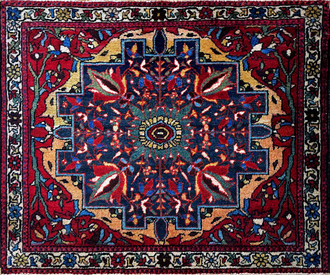
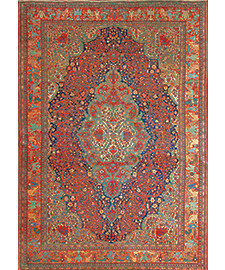
A charming and unusually small antique Feraghan Sarouk rug of fine quality, distinguished by its compact almost-square format and exceptionally strong central design.
The composition is dominated by a large stepped medallion on a deep midnight-blue ground, densely filled with finely drawn flowering vines, leaves and small blossoms.
One of the top high end Persian carpet maker.
The source of this important provenance has been in the village of Sarouk. North of Arak (formerly Sultanabad). Sarouks are known to be of high quality. The pile is usually higher than the average Persian rug and therefore Sarouks are rather heavy and solid rugs, the wool being used is high quality durable wool. "Mohajeran" or "Mahajiran" is the name of a village West of Arak.
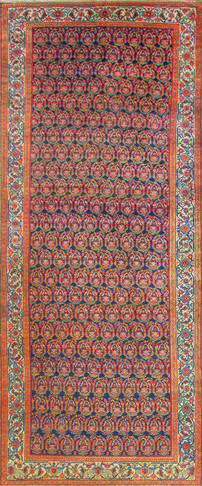
A very attractive and finely woven late-19th-century Persian Senneh Malayer carpet in an unusually desirable long gallery format. The carpet features a dense all-over arrangement of repeating boteh motifs, carefully organized in horizontal rows across a rich, very dark indigo-blue field. This type of boteh drawing has strong associations with both Senneh and Malayer weaving traditions.
Each boteh is intricately worked with small floral elements in shades of madder red, rose, salmon, ivory, soft green, blue and touches of yellow.
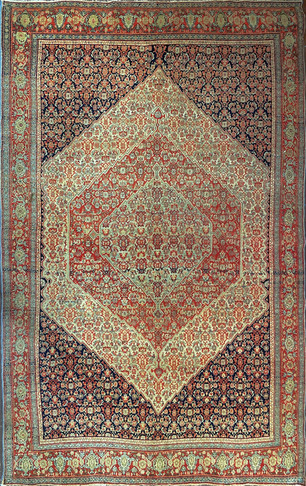
A very fine late 19th-century Persian Senneh carpet, distinguished by its exceptionally intricate drawing, finely woven construction, and striking geometric composition. The design is centered by a large layered diamond medallion, with an ivory outer medallion surrounding a warm madder-red center.
Construction: Hand-knotted silk pile on a silk foundation
Condition: Structurally sound with good pile, but several holes, missing areas, and edge damage. The silk foundation remains stable and the rug is not dry or rotten.
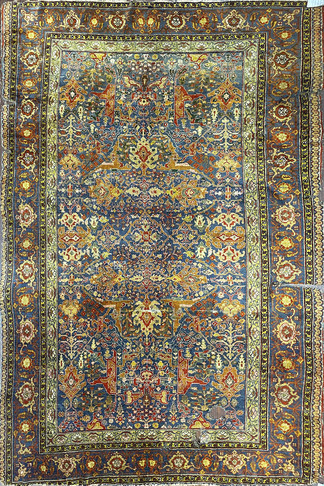
This rare antique Persian Silk Heriz rug is an exceptional survivor from the late 19th century, representing one of the most unusual and collectible variations of Heriz weaving. While Heriz rugs are traditionally woven in wool, silk examples from this period are exceedingly scarce and were likely produced as special commissions for affluent patrons.
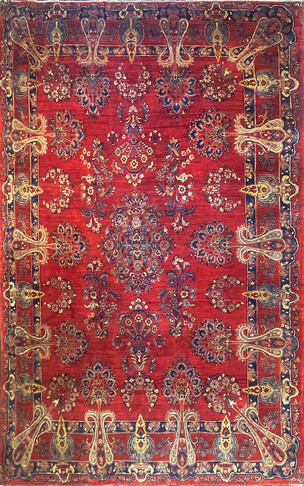
This outstanding Antique Persian Mohajeran Sarouk is an exceptionally decorative example from the celebrated weaving workshops of the Mohajeran district near Sultanabad. Woven around 1910, it is distinguished by one of the most unusual and artistic designs encountered in Sarouk production, making it particularly desirable to collectors seeking something beyond the classic medallion format.
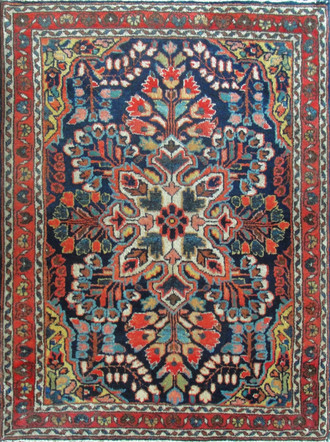
Unlike the more commonly seen Sarouk carpets, this example displays a striking allover floral composition centered on a delicately drawn bouquet rather than a dominant medallion.